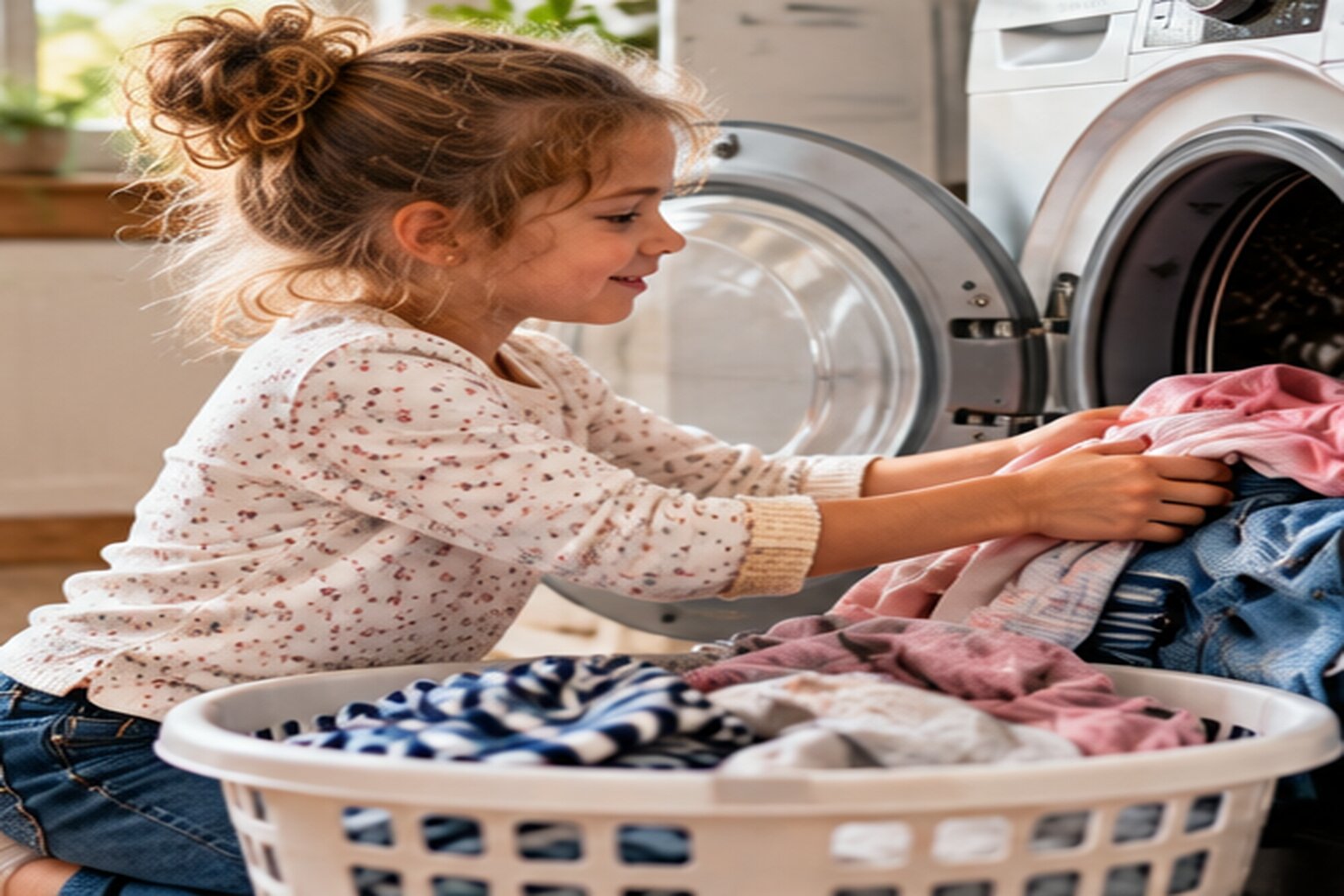
Some children’s clothes spend almost as much time in the laundry basket as they do in the wardrobe.
School polo shirts.
Leggings.
T-shirts.
Joggers.
Nursery clothes.
Sports kit.
For these items, I think wash performance is part of the product.
A garment can look fantastic in the shop and still be poor value if it shrinks, twists, fades or pills after a handful of washes.
I cannot know exactly how a new item will perform, but I can make a much better-informed guess.
I Read the Care Label Before Buying
This is my simplest check.
I want to know whether the garment fits my actual laundry routine.
If children’s everyday clothes require specialist cleaning or unusually delicate handling, I question whether they are right for us.
That does not mean everything must survive the harshest possible wash.
It means I want realistic care instructions.
WRAP’s wash-testing work emphasises that appropriate care-label guidance is important to maintaining garment performance over repeated laundering.
I would rather discover the requirements in the shop than after a laundry accident.
I Think About How Often the Item Will Be Washed
Not every garment needs identical wash durability.
A winter coat may be washed infrequently.
A school polo shirt could be washed every week or even more often.
A pair of leggings used for nursery might face constant laundering.
The more wash cycles I realistically expect, the more attention I give to fabric, seams, colour and decoration.
WRAP’s durability programmes assess clothing across repeated wash and wear cycles because this is one of the central ways garments deteriorate.
I Inspect the Fabric Surface
I look for early signs of fuzziness or pilling.
A soft brushed fabric is not automatically poor quality, but if little fibre balls are already appearing on high-contact areas while the item is still new, I am cautious.
Pilling affects appearance long before a garment physically falls apart.
WRAP specifically includes pilling and colour fading among the types of deterioration associated with clothing being discarded.
I Gently Stretch Jersey
T-shirts, leggings and sweatshirts rely heavily on knitted fabrics.
I gently stretch the material and release it.
I want it to return reasonably close to its original shape.
If a neckline, cuff or waistband already appears loose, washing is unlikely to make that feature more satisfactory.
I pay special attention to ribbed necklines because a stretched neck can make an otherwise usable T-shirt look worn very quickly.
I Look at Seams Before Washing Has a Chance to Expose Them
Poor seams often become more obvious after laundering.
I turn the garment inside out.
I check side seams, underarms and crotch seams.
I want stitching to be reasonably consistent without obvious gaps or large loops.
A seam that is marginal when new may become a failure point after repeated washing and movement.
I Examine Printed Designs
Large prints are one of the things I think about carefully.
Some remain excellent for years.
Others crack or peel.
I flex the fabric gently around the print.
If the decoration feels extremely thick and rigid compared with the surrounding fabric, I recognise that it may age differently from the garment beneath it.
I follow care instructions carefully on decorated clothing, particularly any recommendation about turning garments inside out before washing.
Embroidery Has Different Trade-Offs
Embroidery does not peel like a surface print, but I inspect loose threads.
I also feel the reverse.
A heavily embroidered children’s top can be scratchy against the skin if the inside finish is rough.
A garment that survives washing but is uncomfortable has still failed its purpose.
I Think About Dark Colours
Dark school clothing often needs to remain reasonably dark to look smart.
Black trousers fading to grey may technically remain wearable but no longer match the rest of a uniform.
I therefore pay more attention to wash performance in colour-sensitive garments.
WRAP’s current durability research includes colour fading and wash endurance as specific performance concerns.
Again, I cannot test this in the shop, so past experience with a brand and customer reviews can be useful.
Reviews Can Reveal Patterns
One person reporting shrinkage may have ignored the care label.
Twenty people reporting shrinkage is more significant.
When shopping online, I search reviews for words such as:
washed;
shrank;
faded;
bobbling;
pilling;
colour;
shape.
I am more interested in repeated patterns than star ratings.
A parent who has washed the item ten times often tells me more about durability than someone reviewing it immediately after opening the package.
I Avoid Buying Too Tight Before the First Wash
Some fabrics can change dimensions with care, and I do not want children’s everyday clothing already sitting at the absolute limit.
That does not mean I buy dramatically oversized clothes.
I simply want a comfortable current fit rather than something dependent on remaining precisely unchanged.
I follow the care instructions rather than deliberately sizing for predicted shrinkage unless the manufacturer specifically advises it.
I Look at Elasticated Waistbands
Repeated washing can expose weak elastic quickly.
I stretch the waistband and release it.
It should recover.
I look at how it has been stitched into the garment.
On adjustable waist systems, I check buttons and elastic too.
These parts are repeatedly stretched both in wear and during dressing, so I want them reasonably robust.
I Consider Cotton Blends for Hard-Working Basics
I do not insist that every child’s garment be 100% cotton.
Cotton is comfortable and breathable, but blends can be useful where ease of care and durability matter.
Polyester, for example, is strong, crease-resistant and quick-drying, which helps explain why it is widely used in schoolwear and sports clothing.
A cotton-polyester blend may therefore suit a school polo shirt differently from a soft 100% cotton bedtime top.
I choose according to use.
I Follow the Label Rather Than Automatically Using One Wash for Everything
It is easy to put all children’s clothes through the same routine.
I try not to.
If an item specifies a lower temperature or different drying method, I follow it where reasonably possible.
The care instructions form part of the garment’s design.
WRAP’s extended wash-testing work found that care-label advice can be important in maintaining garment performance through repeated washes.
I Do Not Wash Clean Clothes Simply Because They Were Worn
This depends on the garment and what the child has been doing.
Underwear and heavily soiled clothing obviously need washing.
A jumper worn briefly over another layer may not.
Reducing unnecessary laundering can reduce wear on clothing as well as laundry load.
I use common sense rather than fixed wear counts.
Children are very capable of making the decision for me by covering the garment in mud, paint or lunch.
I Consider Drying Too
Washing is only half of laundering.
The care label may restrict tumble drying.
Heat can affect some fabrics, elastic and decorations.
If I know I rely heavily on a tumble dryer, I check the label before buying.
A garment that requires a drying routine I cannot realistically provide may not be the right everyday choice.
I Keep Successful Products in Mind
When I find a school polo shirt that looks decent after months of washing, I remember the brand.
Likewise with leggings that retain shape or sweatshirts that resist pilling.
Real household experience is valuable evidence.
I do not need to restart the search every time the child moves up a size.
I Accept That Appearance Changes With Use
My goal is not to keep children’s clothes looking untouched.
That would be unrealistic.
I expect some fading, softening and signs of wear.
What I want is graceful ageing.
A good everyday garment should remain presentable and functional for a reasonable period rather than looking exhausted after a few washes.
I Buy for the Laundry Life as Well as the Wearing Life
That is really the main principle.
If I know a T-shirt will be washed repeatedly, wash performance matters just as much as how it looks on day one.
I look at the fabric.
I inspect the seams.
I check the decoration.
I read the label.
I look at reviews.
And when I find something that genuinely survives family laundry, I am very happy to buy it again.
Sources and Research Notes
WRAP’s clothing durability research uses wash endurance, colour fading, pilling and related performance measures when assessing garment longevity.
WRAP’s extended wash-testing work also highlights the importance of care-label advice in maintaining garment performance.
Textile Exchange describes polyester as strong, durable, crease-resistant and quick-drying, explaining some of its practical use in frequently laundered garments.