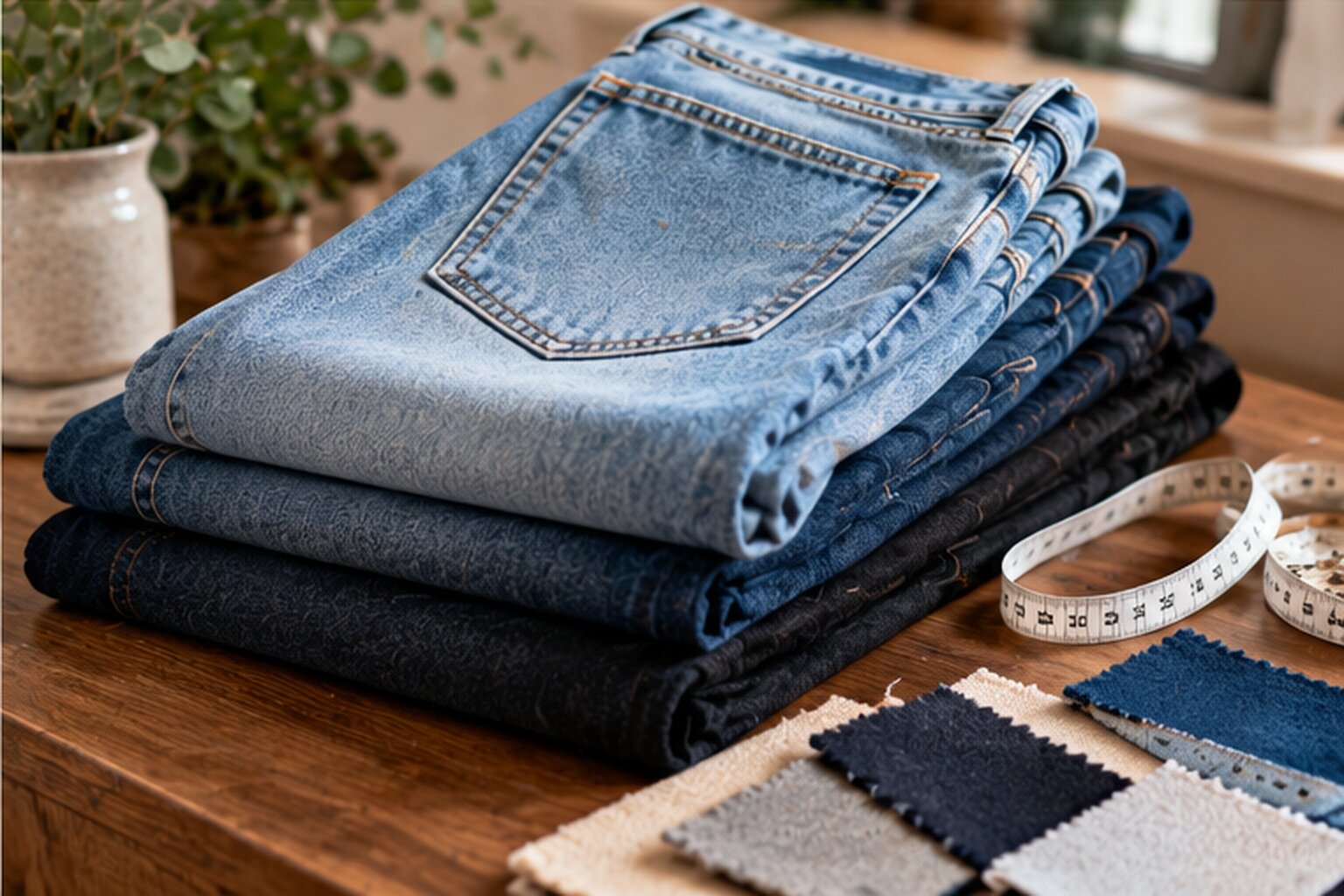
I can put on two pairs of blue jeans in the same size and wonder how they can look so different.
Often the answer is not the obvious things.
Both might be high-rise.
Both might be described as relaxed.
Both might even be made from similar denim.
But one has a slightly curved leg. The other tapers more sharply. One finishes at the ankle. The pockets sit a little higher. The hem is wider.
Those details alter the silhouette.
I have therefore stopped thinking about jeans purely in broad categories such as skinny, straight and wide.
Sometimes the smaller design decisions tell me more about how a pair will actually look.
The Waistband Sets the Starting Point
The height of the waistband establishes where the jean begins visually.
A high waist can make the leg feel as though it starts much higher.
A lower rise changes the relationship between torso and leg.
Even within the same rise category, a centimetre or two can change how comfortable the jeans feel and how they interact with a tucked top.
I therefore pay attention to where the waistband actually sits on me rather than relying solely on “high”, “mid” or “low”.
The Hip Shape Determines What Happens Next
Some jeans follow the hip relatively closely.
Others deliberately include room.
That difference is especially important in relaxed silhouettes.
Take mom jeans.
The style generally combines a defined waist with more room around the hips and thighs before becoming narrower towards the ankle.
Understanding how mom jeans are meant to fit through the waist, hips and leg stops me mistaking their intentional ease for excess fabric.
At the same time, I still want the room to look deliberate.
A loose seat and badly gaping waistband are not automatically design features simply because the jean is relaxed.
A Taper Can Completely Change the Silhouette
I used to pay relatively little attention to leg openings.
Now I see how important they are.
A relaxed jean that remains broad at the ankle behaves very differently from one that tapers.
The narrower hem makes footwear more visible and creates a distinct endpoint.
It also directs the eye back inward after the volume of the upper leg.
That is why mom, carrot and tapered jeans can look so different from apparently similar straight styles.
Curved Seams Create Shape
Barrel jeans make this particularly obvious.
Their defining feature is not simply extra width.
The leg intentionally bows outward before tapering back in.
That means the curved construction of barrel-leg jeans creates shape even when nobody is moving.
A strong barrel can look almost sculptural.
A subtle barrel can resemble a relaxed straight jean until I look carefully at the side seam.
This is why I do not dismiss an entire category after trying one exaggerated version.
Changing the amount of curve changes the garment significantly.
Fabric Weight Controls the Shape
A design line only works in conjunction with the fabric.
Heavy rigid denim holds its shape.
A barrel leg becomes more pronounced.
A wide jean stands further away from the body.
Soft denim collapses and drapes.
That may make the same nominal leg width look considerably less dramatic.
When I like a jean in photographs but dislike it in person, fabric is often part of the explanation.
I may like the silhouette but want it in a softer or firmer material.
Pocket Position Has a Bigger Effect Than I Expect
Back pockets occupy a substantial area of the jean.
Move them slightly higher, lower, closer together or further apart and the rear view changes.
Pocket size matters too.
I do not use rigid rules for the “most flattering” placement.
I simply look at the jeans from behind and decide whether I like what the design is doing.
This is another reason photographs are useful.
I cannot properly assess back-pocket placement by twisting around in front of a mirror.
Pocket Details Change the Mood
Contrast stitching, embroidery, flap pockets and exposed rivets all add visual information.
Minimal back pockets allow the jean shape to remain the main feature.
More decorative pockets draw attention towards that area.
Neither approach is inherently better.
I just want those details to match the role I expect the jeans to perform.
For smarter dark denim, I usually prefer quieter stitching.
For casual jeans, I may enjoy more obvious detail.
The Hem Can Transform the Same Jean
Length is probably the small detail with the largest impact.
Take an ordinary straight jean.
Finish it several centimetres above the ankle and the shoe becomes prominent.
Allow it to meet the shoe and I get a classic full-length line.
Make it longer again and the fabric may begin stacking.
The width of the jean has not changed.
The entire feeling of the outfit has.
That is why I think getting cropped-jeans length and footwear working together deserves more thought than simply buying something labelled “cropped”.
The label tells me the designer’s intention.
My own leg determines the actual result.
Cropped Does Not Mean One Measurement
A crop on somebody taller may become a full-length jean on somebody shorter.
Likewise, a jean photographed as ankle-grazing may finish halfway up my lower leg.
I look at inseam measurements wherever possible.
Then I compare them with jeans I already own.
That immediately gives me more useful information than the product description alone.
Length Matters Differently for Different Cuts
Straight jeans can tolerate a wide range of lengths.
Skinny jeans usually look cleaner around the ankle.
Wide legs can be cropped or floor-skimming, but those two versions create very different silhouettes.
Bootcuts and flares often need additional length so the wider hem can fall over footwear.
This is why I cannot answer how long women’s jeans should actually be with one universal measurement.
The correct length belongs to the style.
The Knee Can Be a Design Point
On straight jeans, I rarely notice exactly where the knee is.
On bootcuts, flares and barrel jeans, it becomes much more important.
A flare that starts significantly below my knee can make the jean look strangely compressed.
A barrel that curves at the wrong point can lose its intended shape.
This is one reason tailoring is not always as simple as chopping fabric from the bottom.
If all the important shaping already occurs too low on my leg, hemming alone will not fix it.
Stitching Can Change the Visual Shape
Contrast stitching creates lines across denim.
That makes construction details visible.
A curved pocket seam, front crease or side seam becomes part of the design.
Thread close to the denim colour makes those same features less noticeable.
When I want jeans that function almost like casual trousers, I often prefer minimal contrast.
When I want traditional denim character, visible golden stitching can be part of the appeal.
Belt Loops and Belts Alter the Waist
A belt is functional, but it also draws a horizontal line around the body.
On a high-rise jean, that line can become a major part of the outfit.
A contrasting brown belt against blue denim is much more visually obvious than a black belt on black jeans.
Sometimes jeans that seem slightly plain come alive once I add a belt.
Other times I prefer leaving the waistband uninterrupted.
Wash Placement Creates Illusions of Construction
Fading can make jeans appear more shaped than they really are.
Lighter areas through the thigh draw attention there.
Dark outer sections can emphasise vertical lines.
Whiskering around the hips adds horizontal detail.
I do not assume these effects are good or bad.
I simply recognise that two identical cuts in different washes may look substantially different.
If I love the fit but dislike the effect of the fading, I look for another wash before abandoning the style.
Raw Hems Draw Attention Downwards
An unfinished hem makes the bottom of the jean much more noticeable.
It works particularly well when I deliberately want the footwear and ankle area to be part of the outfit.
A traditional finished hem is quieter.
This may sound like an insignificant distinction, but on a cropped jean the hem sits directly next to the shoe.
I notice it.
Small Differences Are Why Reordering Can Surprise Me
I have occasionally found a style I loved, ordered another wash and assumed it would fit identically.
Sometimes it does.
Sometimes different denim, washing or finishing changes the behaviour of the garment.
The nominal pattern may be similar, but softness, stretch and shrinkage can alter how the jean sits.
So I treat every pair as an individual garment even when I recognise the product name.
I Look at the Whole Jean Now
My jeans-shopping process used to focus mostly on waist size and leg shape.
Now I look from waistband to hem.
Where does the rise sit?
What happens through the hips?
Does the leg stay straight, curve or taper?
Where is the knee shaping?
How wide is the hem?
Where does that hem actually finish?
What are the pockets and stitching doing?
None of these details needs to be dramatic.
That is exactly the point.
Several small decisions combine to create the final silhouette.
Once I started noticing them, it became much easier to understand why one pair of apparently ordinary jeans looked excellent while another never felt quite right.