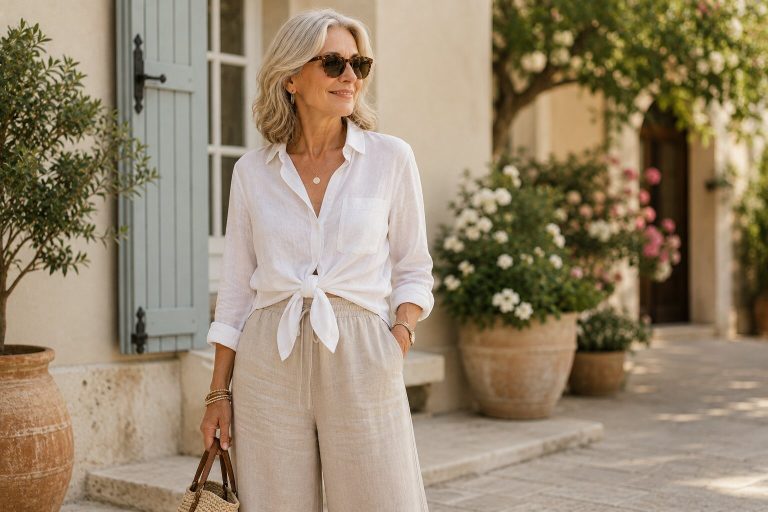
Wide-leg jeans can look wonderfully relaxed and confident.
They can also create far more fabric than somebody accustomed to straight or skinny jeans expects.
That difference is why people sometimes try a pair, look in the mirror and immediately decide that wide denim overwhelms them.
Often the problem is not the entire category.
It is the particular combination of rise, width, length, fabric and styling.
Wide-leg jeans now cover everything from gently roomy denim to dramatic floor-skimming trousers. Finding your version is more useful than deciding whether you are a “wide-leg person.”
The style is firmly established rather than an obscure trend. M&S currently defines wide-leg jeans as relatively fitted through the hip before flowing into a looser leg, while Levi’s describes the category as a structured fit with a roomy leg. British Vogue has continued to feature wide and slightly wide silhouettes throughout 2026.
Start With Width, Not Size
Two pairs labelled wide-leg can have radically different amounts of fabric.
One might be only slightly broader than a relaxed straight jean.
Another may resemble a denim palazzo trouser.
If you are new to the style, begin towards the gentler end.
A modest wide leg gives you the visual effect without completely changing the proportions you are used to seeing.
Once that feels natural, you can decide whether you enjoy more exaggerated versions.
Look at Where the Width Begins
Some wide-leg jeans fit quite closely through the seat and upper thigh before opening out.
Others fall away from the hip almost immediately.
This changes the entire silhouette.
A closer upper fit creates a defined waist-and-hip area followed by volume.
A looser upper section gives a more relaxed column.
Neither approach is better.
The first may feel easier if you want a clear waist. The second works well when you like oversized clothing and a softer outline.
Rise Makes a Big Difference
High-rise wide jeans are extremely common because the defined waist creates contrast with the larger leg.
That contrast can make substantial denim feel purposeful.
Mid-rise versions reduce that effect and can look more relaxed.
Low-rise wide jeans create an entirely different silhouette, often referencing late-1990s or early-2000s denim.
If you feel “swamped,” check the waistband before blaming the leg.
Sometimes moving the waist to a position that feels more natural is enough to make the entire jean work.
Length Is Crucial
British Vogue’s 2026 guide to wide-leg jeans emphasises the importance of a hem that meets footwear at the right point rather than dragging on the ground.
That is especially relevant in Britain, where an elegant floor-skimming hem can become wet denim remarkably quickly.
Full-length wide jeans generally look best when they approach the shoe but remain practical.
Cropped wide-leg jeans create a completely different result.
They expose the ankle and footwear, reducing the overall amount of denim and often making the style feel easier for someone who finds full-length versions overwhelming.
Shoes Change Everything
Wide jeans interact strongly with footwear because the hem is substantial.
A small, slim shoe can almost disappear beneath full-length denim.
That can be exactly what you want.
Alternatively, you may prefer enough shoe to remain visible so the outfit has a clear ending.
Loafers, trainers, ankle boots, ballet flats, sandals and heels can all work.
Who What Wear’s current 2026 styling coverage includes wide-leg denim with shoes ranging from loafers and ballet flats to trainers, riding boots and pointed ankle boots, which illustrates how broad the possibilities are.
If the Jeans Feel Too Big, Show the Waist
This is one of the easiest adjustments.
Tuck in a T-shirt, knit or blouse so the waistband remains visible.
You immediately create a clear point between upper and lower body.
A belt can reinforce the same effect.
This is not a rule. Oversized tops can work beautifully with wide denim.
But when you are first learning to wear the style, visible waist definition can make the proportions easier to understand.
Try a Shorter Top
A top does not need to expose skin to be shorter.
A knit finishing around the waistband, a cropped jacket or a shirt tucked into the front can prevent fabric from continuing uninterrupted from shoulder to floor.
This can be particularly helpful with very wide jeans.
The eye sees where the top ends and the jeans begin.
If you prefer longer tops, choose one that has some structure or a clear hem rather than simply adding another large, loose layer.
Fitted Tops Are Useful—but Not Mandatory
The classic advice is to balance wide trousers with a fitted top.
That works because it creates contrast.
A fitted T-shirt, fine knit or bodysuit can make the wide leg the obvious focus.
However, a loose shirt or oversized jumper can also work.
The difference is intentionality.
When both halves are loose, consider showing a wrist, defining the waist slightly, adding structured footwear or using a jacket to create clearer lines.
You do not need to reduce your body to an hourglass to wear volume successfully.
Jackets Can Organise the Outfit
A cropped denim, leather or utility jacket creates a strong horizontal break close to the waist.
A blazer produces structure through the shoulders and gives the outfit a more deliberate outline.
A long trench or coat can work too, especially when it falls relatively straight over the wide leg.
The most difficult combination is often a shapeless mid-length jacket that ends at the widest visual point of the jeans.
If something feels wrong, experiment with jacket length before changing the jeans.
Fabric Determines Whether They Stand or Flow
Heavy rigid denim produces a bold shape.
It can make the leg look architectural, particularly on barrel-influenced wide styles.
Softer denim falls closer to the body and moves more like a conventional trouser.
If you are worried about being overwhelmed, softer fabric can be an easier introduction.
You still get width, but the garment does not occupy quite as much visual space.
Conversely, if you love the drama of wide jeans, rigid denim can emphasise it.
Dark Wide-Leg Jeans
Dark indigo and black denim can give the style a cleaner, more polished quality.
Pair them with a fine knit, belt and loafers or boots and the jeans can begin to function almost like casual wide-leg trousers.
This makes them useful when you want the comfort of denim but a slightly smarter appearance.
Keep distressing minimal if that is the goal.
Pale Wide-Leg Jeans
Light blue denim highlights the casual origins of the garment.
It works naturally with white shirts, striped tops, trainers, sandals and lightweight jackets.
Because pale denim catches more visual attention than dark denim, an extremely wide pale jean can become the dominant feature of an outfit.
Again, that can be intentional.
If you want something quieter, select a slightly narrower wide leg rather than abandoning the colour.
Wide-Leg Jeans With Knitwear
The combination is particularly useful during autumn and winter.
A fine fitted knit creates a clean contrast.
A chunky jumper creates much more volume.
With the second option, try a partial tuck or allow the jumper to finish around the waistband rather than halfway down the thigh.
Boots can then provide enough visual weight at the bottom of the outfit to support the denim.
Wide-Leg Jeans With Shirts
A crisp shirt and wide jeans can look relaxed but organised.
Tuck it fully for a cleaner line.
Half-tuck it for a less formal effect.
Wear it open over a fitted top for layering.
Denim also responds well to striped shirts because the pattern provides detail without competing heavily with the jeans.
Wide-Leg Jeans With Blazers
This combination can move denim towards smart casual very easily.
The blazer adds structure above while the jeans provide movement below.
You can keep the inside layer simple: a T-shirt, vest or fine knit.
Pay attention to blazer length.
A very oversized blazer with extremely wide jeans creates a deliberately large silhouette. A more tailored jacket gives clearer definition.
Both are legitimate; decide which effect you actually want.
Can Petite Women Wear Wide-Leg Jeans?
Yes. Height does not prohibit a trouser shape.
The more useful question is which proportions make the garment easy to wear.
For somebody shorter, hem length becomes particularly important because excess denim at the floor can quickly dominate the outfit.
Petite-specific ranges may also alter where the rise, knee and pockets sit rather than simply chopping fabric from the bottom.
A slightly narrower wide leg can be a useful starting point, but there is no reason somebody shorter cannot wear a dramatic version if that is the look they enjoy.
What About Taller Women?
Wide denim can make good use of additional length, but tall shoppers have a different problem: finding enough inseam.
A jean intended to be full length can look accidentally cropped if it finishes several centimetres too high.
Look for actual inside-leg measurements rather than relying on labels such as “long.”
Wide vs Baggy
These terms overlap but are not identical.
Wide describes the leg shape.
Baggy normally describes the overall looseness of the garment, including the hip and thigh.
A jean can therefore be wide but relatively fitted around the waist and seat.
Another can be baggy throughout.
If you like the appearance of wide denim but dislike a loose seat, search for styles described as fitted through the hip with a wide leg rather than simply choosing “baggy.”
Wide vs Flare
Wide legs remain roomy through a substantial part of the leg.
Flares are more fitted above the knee and then widen.
This creates very different proportions.
A wide jean produces a column or A-line effect.
A flare emphasises the change between the thigh and lower leg.
Look at side-by-side product photographs and the distinction becomes obvious.
The “Swamped” Test
When an outfit feels overwhelming, identify the specific source.
Is the waist too loose?
Is the rise in the wrong place?
Are the jeans too long?
Is the denim extremely stiff?
Is the top also very long and oversized?
Are the shoes disappearing completely?
Changing one element may solve the issue.
Do not assume the solution is automatically narrower jeans.
Give Your Eyes Time to Adjust
This sounds trivial, but it matters.
When you have worn slim or skinny jeans for years, wide denim can initially look enormous simply because your visual reference point has changed.
Wear them at home with several outfits.
Take photographs.
Try your normal jackets and shoes.
After a few days, you may judge the silhouette differently.
Fashion shifts partly because our eyes gradually become accustomed to new proportions.
Wide Jeans Should Feel Deliberate
The style works best when the volume has a purpose.
That might mean a defined high waist and long dark leg.
It might mean pale cropped denim with loafers.
It could be baggy jeans, an oversized leather jacket and trainers.
There is no single correct formula.
If you feel lost inside the garment, reduce one element: width, length, fabric stiffness or upper-body volume.
Wide-leg jeans are not difficult because they require a particular body type.
They are simply a garment with more fabric, which makes proportion more visible.
Once you find the amount of volume you enjoy, they can be among the most comfortable and adaptable jeans in a wardrobe.
Writers with practical fashion expertise can learn more about contributing through Louie Boutique’s fashion guest-post section.
Sources and Research Notes
Marks & Spencer, Women’s Denim Fit Guide, for the description of its wide-leg fit and current styling guidance.
Levi’s GB, Women’s Denim Fit Guide, for the definition of wide-leg denim as a roomy structured fit.
British Vogue, These Are The Best Wide-Leg Jeans That Will Stand The Test Of Time, for current discussion of wide-leg fit, length and footwear interaction.
British Vogue, How To Style Wide-Leg Jeans, According To The Street-Style Set, for the continuing prominence of straight, wide and cropped denim during 2026.
Who What Wear UK, 2026 wide-leg jeans footwear guidance, for examples of current shoe pairings.