Broad shoulders can be a beautiful feature. They give the body structure, make simple clothes look sharper, and can create a naturally elegant line through jackets, dresses, and knitwear. The challenge is that some clothes add even more width to the shoulder area, which can make an outfit feel top-heavy or less balanced than you intended.
When people ask what to avoid wearing if you have broad shoulders, the answer should never be a harsh list of things you are “not allowed” to wear. Fashion does not work like that. Many women with broad shoulders look fantastic in strong tailoring, sleeveless tops, halternecks, and statement sleeves. The better question is: which details are most likely to emphasise the shoulders, and how can you style them more thoughtfully?
This guide is about awareness rather than restriction. If you want to make your shoulders look softer, narrower, or more balanced with the rest of your body, these are the pieces and styling habits to approach with care. You can still wear what you love. The key is knowing what effect each choice creates.
Avoid Thinking Your Shoulders Are A Problem
Before looking at specific clothes, it is worth saying this clearly: broad shoulders are not a flaw. They can look graceful, athletic, confident, and chic. The aim is not to hide your frame, but to dress it in a way that feels right for you.
Some days you may want to soften your shoulders. Other days you may want to celebrate them with a clean sleeveless top or a sharp blazer. Both choices are valid. Good style comes from intention.
If you have only recently started paying attention to your proportions, our main broad shoulders style guide is a useful place to begin. It gives a wider overview of necklines, sleeves, dresses, trousers, and outfit formulas before you start focusing on what to avoid.
The rest of this article is best used as a guide to visual balance. If something on the list makes you feel wonderful, do not throw it away automatically. Instead, think about how to style it so the whole outfit works.
Be Careful With Strong Shoulder Pads
Shoulder pads are designed to add structure and width. If you already have broad shoulders, they can quickly exaggerate the upper body. This is especially true with sharp blazers, military-style coats, vintage jackets, and boxy outerwear.
That does not mean you can never wear shoulder pads. A small, soft pad can help a jacket sit cleanly, especially if the fabric is lightweight. The problem is heavy padding that extends past your natural shoulder line. This can make the outfit feel wider than your actual frame and may create a squared-off shape.
If you like tailoring, look for blazers with gentle structure rather than dramatic shoulders. Single-breasted jackets are often easier than double-breasted styles because they create a cleaner vertical line. Longline blazers worn open can also be flattering because they draw the eye downward.
When trying on jackets, check the shoulder seam. It should sit close to your natural shoulder edge. If the seam and padding extend beyond that point, the jacket may add more width than you want.
Think Twice About Puff Sleeves
Puff sleeves can be pretty, romantic, and fashionable, but they are one of the most obvious details that add volume to the shoulder area. If the puff begins right at the shoulder and stands out horizontally, it can make broad shoulders look broader.
This is not always a bad thing. A dramatic puff sleeve can look stylish if you enjoy a bold silhouette. But if your goal is balance, choose softer sleeve shapes. A gentle gathered sleeve that falls downward is usually easier than a stiff puff that projects outward.
The fabric matters too. Crisp cotton, taffeta, organza, and stiff poplin hold puff shapes strongly. Jersey, viscose, soft cotton, and draped fabrics tend to fall more gently. If you love feminine tops, look for sleeves with detail lower down, such as a gathered cuff, tie cuff, or slight flare near the wrist.
You can also balance a puff sleeve with the lower half. Wear it with wide-leg trousers, an A-line skirt, or relaxed jeans rather than very slim trousers. The outfit then feels intentional rather than top-heavy.
Avoid Very Wide Boat Necks If You Want Softness
Boat necks create a horizontal line from shoulder to shoulder. On some women, this looks elegant and classic. On broad shoulders, it can also emphasise width, especially if the neckline stretches almost from one shoulder edge to the other.
If you love boat necks, you do not have to stop wearing them. Choose softer versions that are not extremely wide, and balance them with lower-half volume. A navy boat-neck top with wide-leg cream trousers can still look chic. A very wide boat-neck top with skinny jeans may make the upper body feel more dominant.
For a softer effect, try a V-neck, scoop neck, wrap neckline, or open collar instead. These necklines draw the eye down rather than across. If you are deciding between similar tops in a shop, the neckline is often the detail that determines which one flatters more.
This is one reason what looks best on broad shoulders often starts with V-necks and wrap shapes. They are simple, wearable, and easy to adapt for both casual and smart outfits.
Be Wary Of Bardot And Off-The-Shoulder Tops
Bardot and off-the-shoulder tops expose the shoulder line completely and create a strong horizontal shape across the upper body. If you are trying to make shoulders look narrower, they are not always the easiest choice.
However, they can also look beautiful on broad shoulders because they show off the collarbone and create a confident, feminine look. The decision depends on the effect you want. If you want to highlight your shoulders, an off-the-shoulder top can do exactly that. If you want to soften them, a wrap neckline or V-neck may be more flattering.
If you do wear bardot styles, balance them carefully. Try them with a fuller skirt, wide-leg trousers, or a softly draped lower half. Avoid pairing a wide shoulder-baring top with very slim jeans if you feel that combination makes your upper body look too broad.
A slightly asymmetric neckline can be a good compromise. One-shoulder tops still show skin, but the diagonal line can feel softer than a straight-across bardot neckline.
Avoid Tiny Cap Sleeves
Cap sleeves often end at the widest part of the shoulder or upper arm. Because they are short and sometimes stiff, they can draw attention directly to shoulder width. They may also make the upper arm look broader, depending on where they finish.
If cap sleeves do not feel flattering on you, try sleeves that finish slightly lower on the arm. A short sleeve that angles downward, an elbow-length sleeve, a flutter sleeve, or a three-quarter sleeve can all look softer. Sleeveless tops with wider straps can also be better than cap sleeves because they create a cleaner line.
Sleeve fit matters as much as sleeve length. A sleeve that pulls across the upper arm or sticks out from the shoulder will usually add width. A sleeve that drapes close to the arm is often more flattering.
This is one of the easiest changes to make in your wardrobe. You may not need different colours or styles. You may simply need tops with better sleeve proportions.
Be Careful With Epaulettes And Military Details
Epaulettes, tabs, patches, buttons, and military-style shoulder details naturally draw attention to the shoulder line. They were designed to emphasise structure, so they can make broad shoulders look more pronounced.
Trench coats, utility jackets, military coats, and some shirts often have these details. If you love the style, choose softer versions. A trench with subtle epaulettes may be fine, while a stiff military jacket with large shoulder tabs and heavy buttons may feel too strong.
You can also remove epaulettes on some garments if they are attached with buttons or simple stitching. This small alteration can make a jacket much easier to wear.
If you want a casual jacket, consider a soft utility jacket without shoulder tabs, a denim jacket with neat seams, a relaxed blazer, or a long cardigan. These pieces still add interest without placing all the focus at the top of the body.
Avoid Large Collars That Spread Outward
Large collars can be tricky because they sit close to the shoulder line. Wide sailor collars, oversized shirt collars, dramatic lapels, and ruffled collars may all add width to the upper body.
Again, this does not mean every collar is wrong. An open shirt collar can be very flattering because it creates a V shape. A soft rever collar can draw the eye down. The issue is collars that spread outward and create a broad horizontal frame.
If you like collars, look for vertical or open shapes. A shirt worn with the top buttons open can be flattering. A blazer with narrow lapels may work better than one with wide peak lapels. A coat with a clean neckline may feel more balanced than one with a large, dramatic collar.
The simplest test is to look at where the collar sends the eye. If it sends the eye outward toward the shoulders, it will emphasise width. If it sends the eye down toward the centre of the body, it is likely to soften.
Be Selective With Boxy Cropped Jackets
Boxy cropped jackets can add width across the shoulders and stop abruptly at the upper waist. This can make the top half look square, especially when worn with slim trousers or narrow skirts.
Cropped jackets can still work on broad shoulders, but proportion is important. A cropped jacket over a dress with a fuller skirt can look balanced. A short jacket with wide-leg trousers can also work well. The problem usually comes from pairing a stiff, boxy upper layer with a narrow lower half.
If you want an easier jacket shape, try a longline blazer, open cardigan, trench coat, relaxed shirt jacket, or softly tailored coat. These create vertical lines and help the outfit flow downward.
If you already own a cropped jacket you love, style it with lower-half volume. Add wide trousers, an A-line skirt, or a dress with movement. This keeps the jacket from becoming the only strong shape in the outfit.
Avoid Stiff Fabric Around The Upper Body
Stiff fabric holds its shape. Around broad shoulders, that can mean extra width, especially in shirts, jackets, dresses, and tops with structured sleeves.
Crisp cotton shirts, thick denim jackets, stiff poplin tops, and structured dresses can all look good, but they need excellent fit. If the fabric stands away from the body at the shoulders or upper arms, it may create a boxier shape.
Softer fabrics are often easier. Jersey, viscose, soft cotton, silk-style blends, linen blends, fine knitwear, and draped crepe can fall closer to the body without clinging. They create movement rather than bulk.
If you enjoy structured pieces, combine them with softness elsewhere. A crisp shirt can be worn open over a fitted vest. A structured blazer can be worn with fluid wide-leg trousers. A stiff denim jacket can be balanced with a soft midi dress. The goal is not to avoid structure completely, but to avoid stiffness everywhere at once.
Avoid Too Much Detail Above The Bust
Ruffles, frills, bows, embroidery, pockets, sequins, ruching, and heavy prints above the bust can all add visual weight to the upper body. If this detail sits near the shoulders, it may make them look broader.
Detail is not the enemy. Placement is everything. A ruffle at the hem, a tie at the waist, a pleat in the trouser, or a print on a skirt can add personality without widening the shoulders. If you love feminine clothing, choose detail that moves down the body rather than spreading outward across the top.
For example, a blouse with a vertical tie neck may work better than one with large shoulder ruffles. A dress with a soft waist tie may be easier than one with puff sleeves and a ruffled collar. A skirt with print can balance a simple top beautifully.
This is a helpful principle for anyone learning fashion tips for different body shapes, because visual weight can be moved around the body depending on what you want to highlight.
Be Careful With Horizontal Stripes Across The Shoulders
Horizontal stripes can make an area look wider, especially when they sit across the chest and shoulders. A striped boat-neck top, for example, may emphasise broad shoulders more than a vertical stripe shirt or a plain V-neck.
That does not mean stripes are off limits. Stripes are classic, useful, and stylish. If you love them, choose narrower stripes, softer contrast, or styles with a neckline that breaks up the horizontal effect. A striped shirt worn open over a plain top can create vertical lines. A striped skirt can move interest to the lower half.
You can also balance stripes with trouser shape. A striped top with wide-leg jeans will often feel more balanced than the same top with very slim trousers. If the rest of the outfit has enough weight below the waist, the stripes become part of the look rather than the only focal point.
Avoid Very Slim Bottoms With A Strong Top
One of the most common reasons broad shoulders look more pronounced is not the top itself, but what it is paired with. A strong top half worn with very slim trousers or a narrow skirt can make the body look more top-heavy.
Skinny jeans, leggings, pencil skirts, and slim trousers can all work, but they need balancing. If you wear a fitted top with skinny jeans, the shoulder line may feel more obvious. If you wear a long cardigan, open shirt, relaxed jacket, or softer neckline, the outfit may feel more balanced.
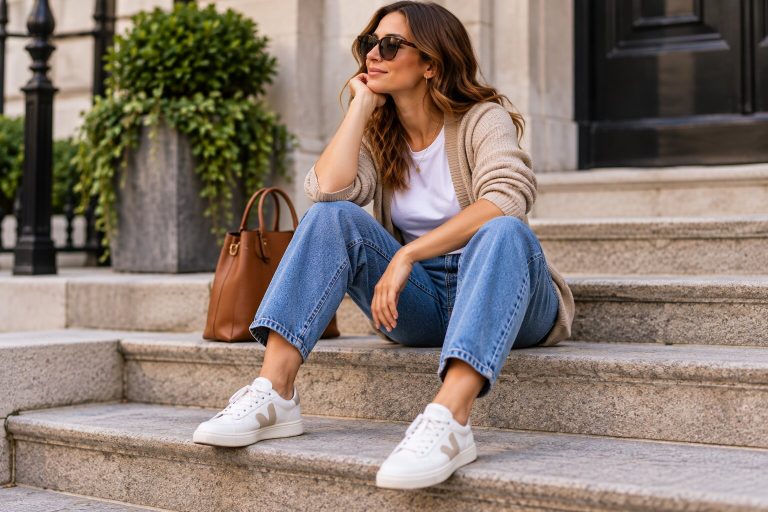
For many women, wide-leg trousers, straight-leg jeans, relaxed trousers, A-line skirts, and midi skirts are easier. They give the lower half more presence, which helps the shoulders feel proportionate.
If you have broad shoulders and narrow hips, this becomes even more important. Our guide to dressing broad shoulders with narrow hips covers this proportion in more depth, especially how to use trousers, skirts, and dresses to create balance.
Avoid High, Tight Necklines If They Feel Heavy
High crew necks, tight roll necks, and very closed necklines can sometimes make the upper body look more solid. This is especially true if the fabric is thick or the top is fitted. The shoulders, bust, and neck can visually merge into one block, which may emphasise width.
That said, some women with broad shoulders look fantastic in roll necks. The difference is usually styling. A fine roll neck under a long blazer can create a sleek vertical line. A chunky high-neck jumper with slim jeans may feel heavier.
If you like high necklines, choose finer fabrics and balance them with lower-half volume or longline layers. You can also add a pendant necklace, open coat, or scarf worn vertically to break up the upper body.
If high necks never feel quite right on you, do not force them. V-necks, scoop necks, open collars, and wrap shapes are usually easier alternatives.
Be Mindful Of Large Shoulder Bags
A bulky shoulder bag sitting directly under the arm can add visual weight to the upper body. If the bag is large, stiff, or carried high on the shoulder, it can make the shoulder area look broader.
This is a small detail, but it can affect the whole outfit. Crossbody bags, handheld bags, top-handle bags, or shoulder bags with a longer drop may feel more balanced. Bags that sit lower on the body help draw the eye down rather than adding bulk at the top.
If you love large shoulder bags, choose softer shapes and avoid overfilling them. A slouchy tote may be easier than a stiff structured bag tucked tightly under the arm.
Accessories should support the outfit. If you are already wearing a strong jacket, high neckline, or statement sleeve, a bulky shoulder bag may be one detail too many.
Avoid Following Every Rule Too Literally
The most stylish women are not the ones who follow every body-shape rule perfectly. They are the ones who understand the rules and then choose what works for them. This is especially true with broad shoulders.
You may love a sharp blazer. You may feel amazing in a halterneck. You may prefer a dramatic sleeve. You may enjoy showing your shoulders rather than softening them. That is all allowed.
The point of knowing what to avoid is not to shrink your wardrobe. It is to make better choices on the days when you want a certain effect. If you want balance, avoid piling detail, width, and stiffness onto the upper body all at once. If you want drama, go ahead and make the shoulders a feature.
For days when your goal is subtle balance, our guide to making shoulders look less broad offers more styling tricks around colour, proportion, layers, and accessories.
What To Wear Instead
If you want easy alternatives, start with softer shapes. Choose V-necks, wrap tops, scoop necks, open collars, raglan sleeves, three-quarter sleeves, soft fabrics, longline layers, and lower-half movement.
Instead of a puff-sleeve top, try a wrap blouse. Instead of a boxy cropped jacket, try a longline blazer. Instead of skinny jeans with a strong top, try relaxed straight-leg denim. Instead of a wide boat neck, try a V-neck knit. Instead of a stiff shift dress, try a wrap dress or A-line midi dress.
These swaps are simple, but they can completely change how an outfit feels. You are not giving up style. You are choosing details that work with your proportions.
For a positive companion piece, the best clothes for broad shoulders can help you focus on what to add to your wardrobe, not just what to avoid.
Dress With Awareness, Not Fear
Knowing what to avoid wearing if you have broad shoulders should make dressing easier, not more stressful. The main things to watch are extra shoulder volume, wide horizontal necklines, stiff upper-body fabrics, bulky collars, strong shoulder details, and very slim lower-half pairings.
But none of these are absolute rules. They are styling signals. If a piece adds width at the top, balance it somewhere else. If a jacket has structure, soften the neckline. If a top is dramatic, add shape below. If you want your shoulders to be the focus, wear the statement proudly.
At Louie Boutique, we believe practical fashion advice should help women feel more confident in their own bodies. If you enjoy sharing outfit advice, body-shape styling tips, or personal fashion experience, our fashion writing opportunities page is a welcoming place to contribute.
Broad shoulders can be styled beautifully. With a little awareness of sleeves, necklines, jackets, fabric, and proportion, you can avoid outfits that feel accidentally top-heavy and choose clothes that feel balanced, flattering, and completely your own.