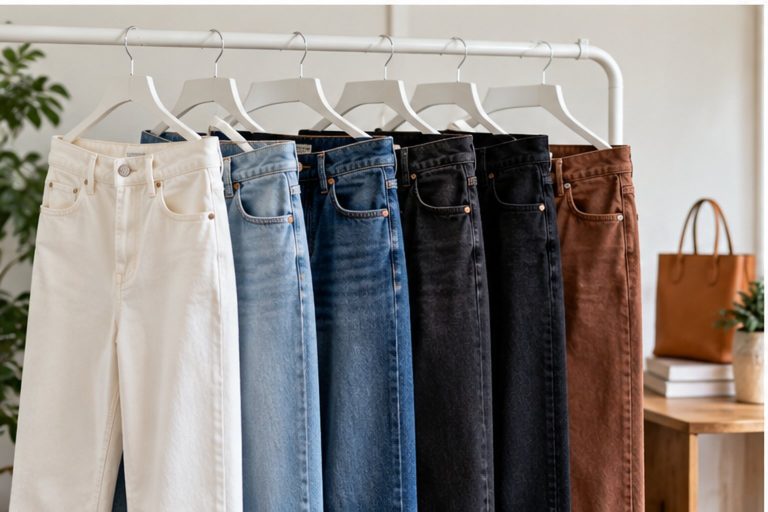
Jeans can look remarkably similar on a rail.
Two pairs may both be dark indigo, straight-legged and made primarily from cotton, yet one may survive years of regular use while the other quickly develops twisted seams, sagging knees or a broken zip.
Price can offer clues, but it does not provide a guarantee.
The better approach is to learn what you can inspect yourself: the denim, seams, pockets, hardware, finishing and overall construction.
You do not need specialist knowledge. A few minutes spent turning a pair of jeans over, looking inside and feeling the fabric can reveal a surprising amount.
Start With the Denim Itself
Pick up the jeans before trying them on.
Feel the fabric between your fingers.
Good denim does not have to be extremely heavy, but it should feel appropriate for the style. A lightweight summer jean may deliberately be soft and fluid. A classic rigid straight jean is likely to feel more substantial.
What you are looking for is consistency.
Check several areas of the garment. Does the fabric feel similarly dense throughout? Does it recover after you gently stretch it? Does it feel excessively thin at obvious stress points?
Hold the denim towards strong light if appropriate.
Lightweight denim will naturally allow more light through, but unusually sparse sections or inconsistent weaving can be warning signs.
Read the Fibre Label
The composition tells you what sort of denim you are buying.
Traditional rigid denim may be 100% cotton.
Stretch jeans commonly mix cotton with a small amount of an elastic fibre such as elastane, while some modern denim also contains fibres such as polyester or regenerated cellulose.
None of these compositions is automatically superior.
A little stretch can make fitted jeans more comfortable. Rigid cotton can provide structure and develop character through wear.
The important thing is that the fabric matches your expectations.
If you want a firm vintage-style jean, a very stretchy blend may disappoint you. If comfort and movement are priorities, an unforgiving rigid fabric may not suit your lifestyle.
Understand the Denim Weave
Denim is traditionally a woven twill fabric.
Its distinctive surface is created by the relationship between warp and filling yarns. Modern manufacturers can also alter the yarn structure to create slub effects, cross-hatching and stretch.
CottonWorks explains that stretch denim may use core-spun yarns, with cotton fibres surrounding a spandex core. The construction allows the material to retain the appearance of denim while gaining elasticity.
You do not need to identify spinning systems while shopping.
What matters is understanding that “denim” covers many different fabrics. A smooth, lightweight stretch jean and a dense rigid selvedge jean are related products, not identical ones.
Look Closely at the Seams
Turn the jeans inside out.
This is one of the quickest ways to see how much attention has gone into construction.
The stitching should generally be:
- reasonably even;
- secure;
- free from long loose threads;
- consistent around curves;
- properly finished at seam ends.
Small variations are normal in a sewn garment. You are not looking for machine-like perfection.
Instead, look for obvious carelessness.
If threads are already pulling out when the garment is new, the finishing is unlikely to improve after months of washing.
Check Stress Points
Jeans experience concentrated strain around:
- pocket openings;
- belt loops;
- the crotch;
- the base of the fly;
- side seams;
- waistband joins.
Look for reinforcement in these areas.
This can involve dense bar-tack stitching, rivets or additional rows of stitching.
Rivets have a functional history rather than being purely decorative. Levi Strauss & Co. traces their use in jeans to Jacob Davis and Levi Strauss’s 1873 patent for reinforcing areas such as pocket openings and other points under strain.
Modern jeans do not need rivets everywhere to be durable, but stress areas should look intentionally constructed.
Pull Gently at the Seams
You can test construction without damaging anything.
Hold the fabric on either side of a seam and apply gentle tension.
The stitching should remain secure. You should not see large gaps opening between the fabric panels.
Pay particular attention to the crotch and inner thigh because these areas experience considerable friction during normal wear.
If the stitches immediately appear strained in a new garment, think about how they will cope after repeated movement and washing.
Inspect the Belt Loops
Belt loops are small but useful indicators.
Check whether they are:
- securely attached;
- positioned evenly;
- reinforced at top and bottom;
- large enough for the belts you normally use.
A loop that is already partly detached in the shop is an obvious warning.
Also look at how the loop meets the waistband. Good construction should appear deliberate rather than as though the loop has been caught by only a few loose stitches.
Test the Zip
Open and close it several times.
It should move smoothly without catching the surrounding denim.
Check that:
- it sits flat;
- the slider feels secure;
- teeth align properly;
- stitching around the fly is even;
- the zip does not begin opening again under light tension.
A beautiful pair of jeans with unreliable hardware will rapidly become irritating.
Button flies require similar inspection. Buttons should be firmly attached, and buttonholes should be clean enough to use without excessive force.
Look at the Main Button
The waistband button carries repeated tension.
It should feel solid rather than loose.
Check the reverse of the fastening too. The attachment should look secure and should not already be distorting the surrounding fabric.
Decorative branding is irrelevant to function. A plain secure button is more valuable than impressive-looking hardware that moves when touched.
Check the Pockets Properly
Put your hands inside them.
Are they deep enough to be useful?
More importantly for quality, look at the pocket bags inside the jeans.
Very thin pocket fabric can wear before the denim itself, particularly if you regularly carry keys or a phone.
Check whether seams are enclosed and whether the pockets are firmly attached to the main garment.
Back pockets deserve attention too. Their top corners experience repeated strain, which is one reason reinforcement has long been associated with jean construction.
Check Whether the Legs Hang Straight
Hold the jeans by the waistband and let the legs fall freely.
Do the side seams travel relatively straight down the garment, or does one leg appear to twist?
Some design details deliberately create curved or twisted seams, particularly on contemporary jeans, so consider the intended style.
On conventional straight or slim jeans, however, strong unintentional twisting may suggest cutting or construction problems.
Try the jeans on and look from several angles.
A seam that rotates significantly towards the front or back can become more noticeable after washing.
Compare Both Legs
Lay the jeans flat if possible.
The two legs should broadly mirror one another unless asymmetry is part of the design.
Compare:
- leg length;
- hem width;
- pocket position;
- seams;
- distressing;
- stitching.
Washed and distressed denim will naturally vary, particularly when finishing processes intentionally create an individual appearance.
Structural asymmetry is a different matter.
Inspect the Hem
Turn up the bottom of each leg.
Look for an even line of stitching and a securely finished edge.
The hem should not already be unravelling unless the jeans intentionally have a raw or distressed finish.
With raw hems, examine whether the distressing appears controlled. A raw edge can be a perfectly legitimate design choice, but it should still look like the garment was deliberately made that way.
Do Not Confuse Selvedge With Automatic Quality
Selvedge denim has acquired a premium reputation.
The term refers to the self-finished edge produced during weaving, often visible when jeans are turned up. Levi Strauss describes selvedge as the vertical edge of denim that prevents the fabric edge from unravelling.
Selvedge can accompany very high-quality denim, but the presence of that edge does not magically make every aspect of a jean superior.
The fit, sewing, fabric and finishing still matter.
Likewise, non-selvedge jeans can be exceptionally well made.
Buy the garment, not the terminology.
Consider Fabric Weight—but Carefully
Heavy denim often feels substantial, which can be reassuring.
It is not automatically better.
Weight affects:
- comfort;
- drape;
- breathability;
- break-in time;
- seasonality;
- silhouette.
A heavy rigid denim can be excellent for structured straight jeans but unsuitable for a soft wide-leg summer style.
Quality means the fabric is appropriate and performs well, not simply that more material has been used.
Examine the Wash
Denim can be washed, faded, whiskered, distressed, coated or left relatively raw.
Look closely at intentionally faded areas.
Do they appear convincing and well placed?
More importantly, has the treatment weakened the cloth?
Heavy distressing around knees and thighs deliberately removes some fabric strength. That may be an acceptable trade-off if you love the appearance, but it means those areas should not be expected to behave like untouched denim.
Pre-cut holes and abrasive fading may shorten the time before genuine wear becomes visible.
Look for Colour Consistency Where It Matters
Uniform colour is not always the goal with denim.
However, accidental streaks, uneven patches or badly transferred dye can indicate finishing issues.
Check pale garments especially carefully because marks may be easier to notice.
With dark indigo, some dye transfer can occur, particularly when denim is new. Consider how you will use the jeans around pale footwear, upholstery and handbags.
Check the Waistband Construction
The waistband should lie smoothly when the jeans are fastened.
Look for:
- twisting;
- puckering;
- sections where fabric has been caught unevenly;
- loose stitching;
- misaligned belt loops;
- a button that pulls the fabric excessively.
A structured waistband helps jeans maintain their position, so this is not an insignificant detail.
Assess Stretch Recovery
If the jeans contain elastane, gently stretch a small section and release it.
Does it return reasonably close to its previous shape?
A fabric that remains obviously stretched after mild handling may struggle with bagging at the knees or seat.
Of course, a shop test cannot predict months of wear.
It can, however, help compare two pairs.
If one feels springy and controlled while the other feels loose and easily distorted, you have learned something useful.
Quality Is Not the Same as Stiffness
This misconception can make shopping harder.
Soft jeans are not necessarily cheap. They may use deliberately lightweight fabric, garment washing or fibres chosen for drape.
Similarly, stiff jeans are not automatically durable.
Judge whether the fabric feels stable and intentional for the product.
The question is not “Does this feel tough?” but “Does this feel like a fabric capable of performing the job these jeans are designed to do?”
Quality Is Not the Same as Price Either
A higher price can reflect many things:
- fabric;
- manufacturing;
- design;
- brand positioning;
- retail overheads;
- marketing;
- lower production volumes.
Some will contribute directly to garment quality and some will not.
That is why inspection remains valuable even when buying premium jeans.
Turn them inside out just as you would a £30 pair.
Check Care Instructions Before Buying
Beautiful jeans that require a level of maintenance you will never provide are not a good purchase for you.
Read the care label.
Consider whether the garment can fit into your normal laundry routine and whether unusual finishes require special handling.
Proper care can extend the useful life of denim, but only if the recommended process is realistic.
Fit Is Part of Quality
A beautifully constructed pair that does not fit your body is still a poor purchase.
Fit affects durability too.
Jeans that are excessively tight may experience more strain around seams, pockets and thighs. Jeans that are too loose may drag at the hems or create repeated friction in different places.
Quality and fit should therefore be assessed together.
Think in Terms of Cost Per Wear
A £100 pair worn twice is expensive.
A £60 pair worn 100 times has delivered much more practical value.
When choosing between similar jeans, ask which pair you genuinely expect to reach for repeatedly.
A versatile wash, comfortable rise and useful leg shape may add more value than an unusual design detail.
A Five-Minute Quality Check
Before buying, try this routine:
- Feel the denim.
- Read the fibre composition.
- Turn the jeans inside out.
- Inspect crotch and inner-leg seams.
- Check pockets and belt loops.
- Test the zip or buttons.
- Look at the waistband.
- Hold the legs up to check alignment.
- Stretch the fabric gently if appropriate.
- Try them on and move around.
No single feature proves that jeans are excellent.
Together, however, these observations create a much better picture.
Buy the Jeans, Not the Marketing Story
Denim comes with an unusually rich vocabulary: rigid, comfort stretch, selvedge, ring-spun, raw, vintage wash, authentic, premium and many more.
Those descriptions can be useful, but they should help you understand the product rather than persuade you to stop examining it.
Good-quality jeans should make sense when you inspect them.
The fabric should suit the style. The seams and stress points should feel secure. The hardware should work. The garment should hang correctly and fit comfortably.
Learn those signals and you become far less dependent on the logo stitched onto the back.
Anyone with specialist fashion knowledge who is interested in contributing to Louie Boutique can explore its fashion guest post page.
Sources and Research Notes
CottonWorks, technical information on denim construction, yarns and elastic core-spun denim.
CottonWorks, garment manufacturing information covering jeans as a comparatively complex sewn garment.
Levi Strauss & Co., historical information on the use of rivets to reinforce denim at points of strain.
Levi Strauss & Co., explanation of selvedge denim and its self-finished woven edge.