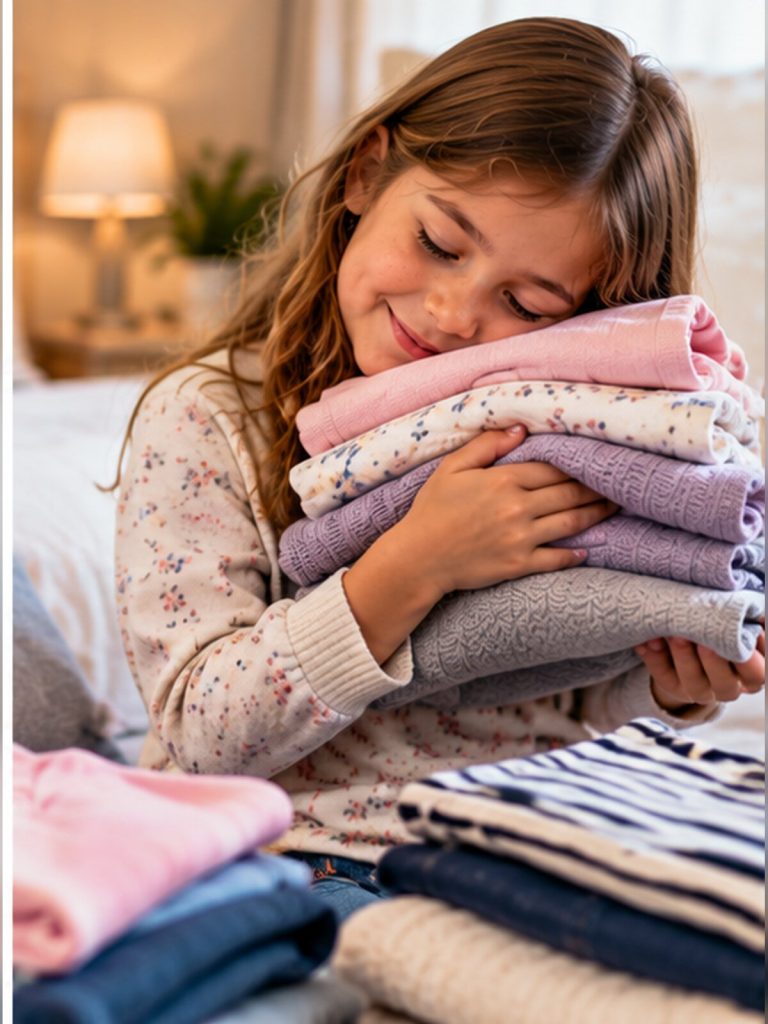
There is an awkward stage in children’s clothing when the younger ranges start looking or feeling wrong but moving into older clothes does not immediately solve the problem.
The child’s body may be changing quickly.
Their taste may be changing even faster.
One retailer may still call their size children’s clothing, another may describe it as older kids, and another may place similar garments in a teen range.
I find this much easier once I stop looking for the point at which a child officially becomes a “tween”.
There is no universal clothing size where that happens.
I concentrate instead on measurements, fit, style and what the child actually wants to wear.
I Treat Tween as a Shopping Description, Not a Size
The word “tween” is useful because it describes the period between younger childhood and the teenage years.
It is much less useful as a sizing system.
Retailers organise this age range differently.
Next’s current children’s size guide, for example, continues single-year sizes through ages 16, with its broader school guide extending some sizing information through 17 and 18. It still bases those age sizes on height, chest, waist and hip measurements rather than treating the age number as the measurement itself.
That tells me something important.
I do not need to identify the correct retail category first.
I need to identify the correct garment.
Growth Can Become Less Predictable
This stage can be particularly frustrating because children do not necessarily grow evenly.
One year, trousers may suddenly become too short.
Another, tops may become tight through the shoulders or chest.
A child can move into an older size for one type of clothing while remaining in a younger size for something else.
I therefore remeasure rather than assuming that the size which worked six months ago remains useful.
Height gives me a starting point.
Then I consider chest, waist, hips and inside leg according to the garment.
I Stop Expecting One Size to Cover the Whole Wardrobe
This is perhaps the biggest adjustment I make.
A child may need one size in tops and another in trousers.
They may need a longer trouser length but a relatively narrow waistband.
They may need extra room through the chest without longer sleeves.
None of this is unusual.
Next’s current older-child sizing illustrates how measurements diverge as children grow, and selected ranges also offer slim and plus fits rather than assuming one standard body proportion.
I use those alternatives where they help rather than endlessly increasing or decreasing the age size.
Style Becomes More Important Too
Younger children’s clothing is often selected primarily by adults.
As children move towards the tween years, many become much more aware of what they like.
That can create a second fit problem.
A garment might physically fit but feel too childish.
Alternatively, moving immediately into older teen fashion may produce clothing that feels too mature for the child.
I try to separate these issues.
One question is: does it fit?
The other is: does the child actually like it?
Both matter.
I Let the Child Lead More of the Style Decision
At this stage I begin offering more meaningful choices.
Instead of buying six tops and hoping they approve, I might identify several practical options within budget and let the child choose between them.
That gives them some control without turning the entire shopping trip into an unrestricted spending exercise.
I also pay attention to what they already wear repeatedly.
If every brightly patterned top remains untouched while plain sweatshirts are worn constantly, I accept the evidence.
There is little point buying clothing for the child I imagine rather than the one getting dressed each morning.
I Buy Fewer Clothes While Sizes Are Changing Quickly
Rapid growth makes this a good time to avoid overbuying.
If a child is clearly approaching the upper end of a size, I do not buy ten new T-shirts in it.
I buy enough to solve the immediate wardrobe need and see what happens next.
This is especially useful when the child is moving between retail ranges.
I may need to test a few brands before discovering which older-kids sizing works best.
Buying gradually reduces the risk of ending up with a pile of almost-new clothing that no longer fits.
I Pay Close Attention to Trouser Fit
Trousers often expose the transition problem fastest.
The child may need significantly more leg length without a corresponding increase in waist size.
Adjustable waistbands can be extremely useful.
Slim-fit alternatives can also prevent me having to choose between correct length and a waist that is far too large.
Conversely, if the waist or hips need more room, I look for generous or plus fits rather than automatically buying much longer trousers.
The goal is targeted fit.
I Am Careful With Adult Sizes
Sometimes a child becomes tall enough to fit the smallest adult clothing sizes while still having very different proportions.
An adult garment may have:
- a different shoulder shape;
- longer body proportions;
- different hip shaping;
- a lower neckline;
- longer sleeves;
- different styling details.
I do not assume that because an adult size technically fastens, it is automatically the better choice.
I compare it with older children’s or teen-specific clothing.
Whichever garment fits and feels appropriate wins.
I Consider Fabric and Comfort More Than Before
Children at this age can become particularly clear about clothing discomfort.
They may dislike a waistband they previously tolerated.
They may object to stiff fabrics, scratchy labels or tight collars.
Some of this may simply reflect greater confidence in expressing preferences.
I take those comments seriously.
The best-value garment is not the one that lasts longest on paper.
It is the one the child actually wears.
Basics Make the Transition Easier
When I am unsure about style or sizing, I focus on uncomplicated pieces.
Plain T-shirts.
Sweatshirts.
Jeans or casual trousers in colours the child already likes.
Simple knitwear.
A practical coat.
These pieces can bridge different style phases more easily than highly specific fashion items.
Once I understand the child’s new size and preferences, I can add more distinctive clothing if they want it.
I Watch Out for Suddenly Different Proportions
Moving into older ranges can change more than size.
Tops may become more cropped or oversized.
Trousers may become wider.
Sportswear may become more fitted.
I therefore read the product description rather than assuming an age 13 garment is simply a larger version of age 12.
Fashion becomes a bigger influence as ranges get older.
Sometimes what looks like a sizing problem is actually a deliberate cut.
I Check the Same Garment in More Than One Size
If the child sits between two sizes, I often order or try both where practical.
Direct comparison is much easier than guessing.
I check:
- shoulders;
- sleeve length;
- waistband;
- trouser length;
- ease of movement;
- how the child feels wearing it.
The larger size is not automatically better because it offers growing room.
The smaller size is not automatically better because it looks neater.
I choose the one that works now while allowing sensible flexibility.
I Avoid Making the Transition About Their Body
This is particularly important as children become more body-aware.
I do not say they are “too big for kids’ clothes” or “too skinny for teen sizes”.
The clothing is simply cut differently.
I talk about the garment.
“These trousers are too short.”
“This top is too wide in the shoulders.”
“Let’s try another size.”
That keeps the shopping problem where it belongs: with the clothes.
I Expect to Use More Than One Retailer
One retailer may be excellent for trousers.
Another may make sweatshirts that fit particularly well.
A third may offer the sort of styles the child likes.
I do not expect one shop to solve everything.
Once I find a successful brand or product, I make a note of the size and measurements.
That gives me a reference point for future shopping.
The Transition Does Not Need One Big Wardrobe Change
I think this is the most useful lesson.
I do not need to decide one weekend that the child has left children’s clothes behind and replace everything.
The wardrobe can change gradually.
Old clothes continue working until they are outgrown or no longer wanted.
New pieces come from whichever range currently fits best.
Over time, the balance naturally shifts.
That approach costs less, wastes less and avoids turning an ordinary stage of growth into a complicated shopping milestone.
The best clothing category is simply the one containing clothes that fit the child comfortably, suit what they are doing and feel like something they actually want to wear.
Sources and Research Notes
I used Next’s current older-children and school sizing information to check the breadth of age ranges and the relationship between age labels and actual body measurements. Next continues children’s sizing through the teenage years and explicitly treats age as an approximation rather than the primary measurement.