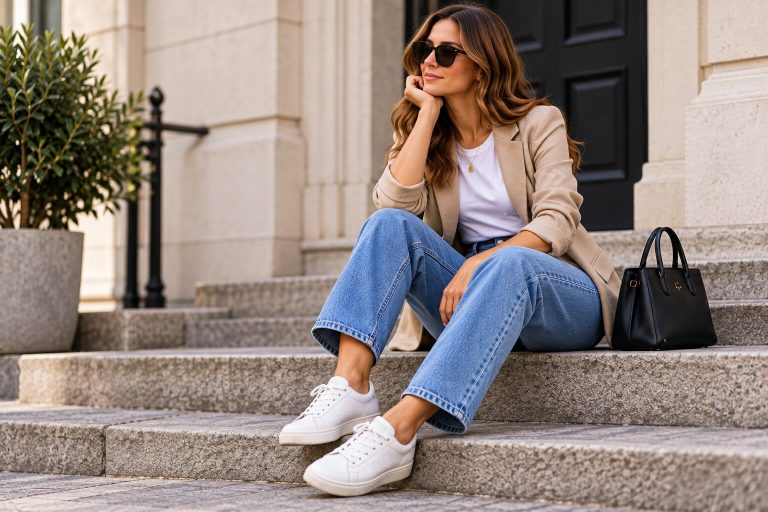
Straight-leg jeans occupy a useful middle ground.
They are neither as close-fitting as traditional skinny jeans nor as deliberately voluminous as wide-leg or baggy denim. Instead, the leg maintains a relatively consistent width from around the knee towards the hem.
That apparent simplicity is one reason straight jeans remain so useful.
They can be worn with trainers and a sweatshirt, boots and a winter coat, loafers and a shirt, or heels and a blazer without the jeans dictating the entire outfit.
Their current popularity is not simply nostalgia. British Vogue identified classic straight-leg jeans as one of the key denim shapes of 2026, describing them as part of a broader return to relatively timeless silhouettes.
The more important question, however, is not whether straight jeans are fashionable.
It is which version works for you.
What Exactly Counts as Straight-Leg?
Levi’s describes a classic straight fit as having the same width at the knee and leg opening.
That gives you the basic idea, but retailers still interpret straight jeans differently.
Some fit closely through the hips and thighs before falling straight.
Others are relaxed almost from the seat down.
Some finish at the ankle. Others extend over the shoe.
The result can range from neat and almost tailored to deliberately slouchy.
When shopping, therefore, treat “straight” as a family of shapes rather than one precise pattern.
Slim Straight vs Relaxed Straight
This distinction matters.
Slim-straight jeans follow the thigh relatively closely and then continue in a clean line. They can be a useful transition if you are accustomed to skinny jeans but want something less fitted below the knee.
Relaxed straight jeans leave more space through the upper leg. They can feel more casual and may produce a stronger 1990s-inspired effect.
Neither is more correct.
Look at the whole silhouette rather than focusing on the label.
If the jean feels tight through the thigh but you wanted a relaxed appearance, moving up a size may simply make the waist too large. You may need a different straight cut instead.
Choosing the Rise
Straight jeans work at almost any rise.
A high rise can emphasise the waist and create a relatively long uninterrupted leg line.
Mid-rise straight jeans often feel neutral and easy to combine with both tucked and untucked tops.
Low-rise versions create a more overtly relaxed or early-2000s influence.
The best rise depends partly on your torso and partly on styling.
If you enjoy tucked shirts and shorter jackets, a higher rise makes the waistband part of the outfit.
If you prefer long tops and looser layers, the exact height may be less visually important, although comfort still matters.
Get the Thigh Fit Right
The thigh determines whether your straight jeans look genuinely straight or accidentally skinny.
Stand naturally and look at the denim around the upper leg.
A classic straight pair normally needs enough room that the fabric can continue downwards without tightly tracing every part of the leg.
That does not mean it must be loose.
The aim is a coherent line.
If the denim is very tight until the knee and considerably wider below it, you may have created something closer to a slim or cigarette silhouette.
Think Carefully About Length
Length transforms straight jeans.
An ankle-length straight jean creates a visible gap between trouser and shoe. This makes footwear prominent and can feel particularly clean with loafers, ballet flats or trainers.
A full-length straight jean produces a longer line and may sit over part of the shoe.
A slightly longer relaxed straight can even gather gently around footwear.
All three can work.
Decide which result you want before altering the hem.
British Vogue’s coverage of straight jeans in 2026 has shown versions worn with loafers, ballet flats and boots, demonstrating how much the styling can change while the underlying jean remains simple.
Straight Jeans and Trainers
This is perhaps the easiest combination.
Straight jeans work with simple leather trainers, canvas shoes and more substantial retro trainers because the hem does not usually compete aggressively with the footwear.
With cropped jeans, the entire shoe is visible.
With full-length versions, check that the hem does not collect awkwardly on top.
A small amount of fabric break can look relaxed. Excessive bunching can make a deliberate straight leg appear untidy.
Straight Jeans and Loafers
Loafers introduce a smarter element without making the outfit formal.
An ankle or slightly cropped straight jean works especially well because the shoe remains visible.
Add a shirt, fine knit, trench coat or blazer and the same jeans can move from casual weekend wear towards a polished everyday outfit.
Socks then become a deliberate styling choice.
A visible neutral sock produces a different effect from a bare ankle or a bold colour.
Straight Jeans and Boots
Ankle boots work with both cropped and full-length straight jeans.
With a narrow boot, the hem may fall over the top.
With a bulkier boot, you need enough leg opening to avoid the denim catching.
Tall boots are less straightforward than they are with skinny jeans because straight denim creates more fabric inside the shaft.
Instead of forcing them in, consider footwear designed to sit beneath the hem.
What Tops Work?
Almost anything, which is the point.
A plain T-shirt and straight jeans create a neutral base.
A tucked shirt makes the waistband and rise more visible.
A fitted knit provides contrast with a relaxed straight leg.
An oversized jumper creates a softer, more casual silhouette.
Rather than asking which top is “allowed,” think about where you want the visual volume.
If the jean is a very relaxed straight, a neater top can clarify the proportions.
If the jean is slim and simple, you have more freedom to add volume above.
Jackets and Coats
Straight jeans are particularly easy with outerwear because they do not strongly dictate proportion.
A cropped jacket can emphasise the waist.
A blazer creates a long upper-body line.
A trench works naturally with full-length denim.
An oversized leather jacket can push the outfit towards a more relaxed style.
Long wool coats also work because the clean leg shape continues beneath them without introducing another large area of volume.
Should You Tuck Your Top In?
Only if it helps the outfit.
Tucking reveals the waistband and makes the rise more obvious.
This can be useful with high-waisted straight jeans.
A half-tuck provides some definition without creating a very structured result.
Leaving the top untucked can work just as well, particularly when the hem ends around the upper hip.
The common advice to tuck everything into jeans is unnecessary.
Judge the length and volume of the particular top.
Blue Straight Jeans
Mid-blue is perhaps the most versatile version.
It works with black, white, cream, navy, grey, brown, burgundy, olive and many brighter colours.
Pale blue denim creates a more obviously casual effect and often feels especially appropriate in spring and summer.
Dark indigo looks cleaner and can support smarter shoes and outerwear.
If you are buying your first straight pair, choose the wash that works with the jackets and shoes you already own rather than automatically defaulting to whatever is currently fashionable.
Black Straight Jeans
Black denim can sit somewhere between jeans and casual trousers.
A clean pair without strong fading works well with boots, loafers and tailored jackets.
Washed black creates a softer, more casual appearance.
Be aware that black denim changes noticeably with laundering. If you want to preserve a dark surface, follow the manufacturer’s care instructions rather than washing it automatically with every wear.
White and Ecru Straight Jeans
Pale denim can make the straight silhouette particularly clear.
White, cream and ecru jeans work with summer shirts, striped knits, suede jackets and darker winter layers.
They are not restricted to hot weather.
Cream denim with brown boots and a dark wool coat can work extremely well in autumn or winter.
The practical consideration is simply that pale jeans show marks more readily.
Rigid or Stretch?
Both can work.
Rigid cotton gives straight jeans structure and helps them maintain a defined line.
Stretch makes them softer and potentially more comfortable through the waist and hips.
If you want a traditional denim appearance, start with rigid or low-stretch fabric.
If you spend long periods sitting or prefer immediate softness, a little elasticity may be more useful.
The key is avoiding fabric so stretchy that a clean straight silhouette turns into a close-fitting one after several hours.
Straight Jeans for Work
Whether denim is appropriate depends on the workplace, but where jeans are accepted, dark straight styles are among the easiest to make polished.
Choose relatively clean denim without heavy distressing.
Add loafers or boots, a shirt or simple knit and a structured jacket.
The outfit still looks like denim, but the straightforward silhouette avoids introducing unnecessary visual informality.
Straight Jeans for Evenings
Changing the shoe and top may be enough.
Dark straight jeans with a silk-style blouse, fitted knit, camisole and jacket, or strong jewellery can move into evening territory without needing a completely separate denim wardrobe.
A slight crop can work particularly well with elegant footwear because it allows the shoe to remain visible.
The Most Common Fit Problem
Straight jeans are often bought too tight.
People accustomed to skinny denim sometimes expect every part of a jean to closely follow the body.
That can undermine the straight silhouette.
Give the fabric enough room to fall.
The opposite problem also occurs: buying a much larger size in pursuit of a relaxed look.
This can cause waist gaping and poor pocket placement.
Look for a cut designed with the amount of ease you want.
Another Common Problem: The Wrong Hem
An otherwise good pair can feel awkward when the hem lands at an unhelpful point.
Try them with at least two pairs of shoes before deciding.
If you alter the length, pin the hem first and photograph the result.
Removing two centimetres can make a surprisingly large visual difference.
Why Straight Jeans Keep Working
Straight-leg jeans do not depend on an extreme silhouette.
That gives them longevity.
British Vogue’s 2026 coverage has described the straight leg as an enduring shape and a useful alternative to both baggy and skinny denim.
That does not mean everybody needs a pair.
It means the style is relatively resistant to dramatic changes in fashion because the basic proportions are simple.
Build Around Your Own Version
The phrase “straight jeans” tells you less than you might initially think.
You still need to choose rise, thigh room, wash, fabric and length.
Once you get those decisions right, however, the jeans become extraordinarily easy to use.
Wear them casually with trainers, sharpen them with loafers, add boots in winter or change the top and jacket for evening.
A good straight jean does not demand a complicated styling system.
That is precisely why it earns its place in so many wardrobes.
Fashion writers and people with useful clothing expertise can find more information through Louie Boutique’s fashion contributor page.
Sources and Research Notes
Levi’s GB, Women’s Denim Fit Guide, for the definition of straight-leg jeans and current fit categories.
British Vogue, From Miniskirts To Straight-Leg Jeans – Vogue’s Guide To 2026’s Denim Trends, for the continuing prominence of classic straight-leg denim in 2026.
British Vogue, How To Wear Straight-Leg Jeans Like An Off-Duty Model In 2026, for current examples of straight jeans styled with loafers, flats and boots.
British Vogue, Why Every Wardrobe Needs A Pair Of Straight-Leg Jeans, for discussion of the style’s enduring versatility.