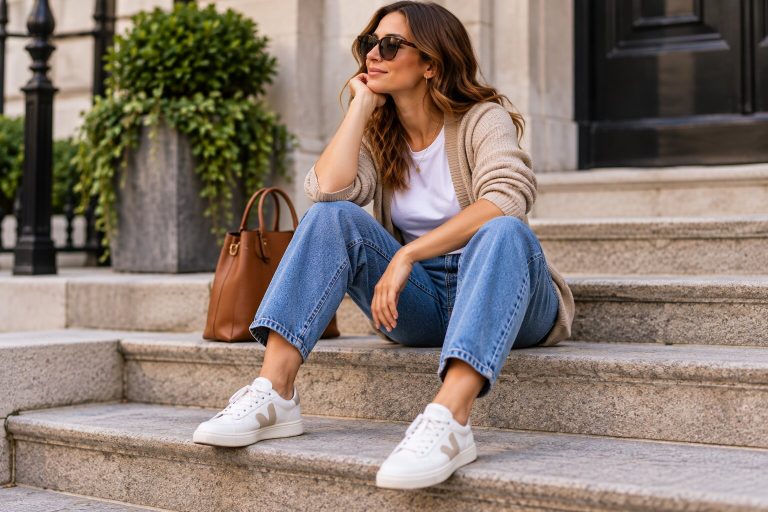
Buying jeans online can feel like one of fashion’s least promising ideas.
Even in a shop, you may need to try several pairs before finding the right waist, rise and length. Online, you lose the ability to feel the denim, check the waistband and immediately compare sizes.
Yet online jeans shopping also has advantages.
You can access more lengths, sizes and fits than many physical shops carry. Product reviews can expose recurring sizing problems. Detailed measurements allow you to shop more systematically rather than simply taking six pairs into a changing room.
The key is to stop thinking of your usual clothing size as the main piece of information.
Measurements, fabric composition, garment shape and comparison with jeans you already own provide far better evidence.
Forget What Size You Think You Are
Start here.
A UK size 12 is not one universal physical object.
Retailers develop their own patterns and sizing systems, while different jeans within the same brand may be cut differently.
M&S explicitly notes that fit can vary according to cut, style and fabric.
This means “I am always a 12” is less useful than knowing your actual waist and hip measurements.
Treat the size label as the final conversion step rather than the starting point.
Take Your Measurements
You need only a soft measuring tape.
The most useful measurements are:
- waist;
- hips or seat;
- inside leg;
- sometimes upper thigh.
Levi’s advises measuring the waist around its smallest point, the seat around the fullest part of the hips, the thigh near its widest point and the inseam down the inside leg.
M&S similarly advises measuring the natural waist, fullest part of the hips and inside leg rather than measuring over clothing.
Write the numbers down.
Do not rely on memory.
Measure Yourself in Underwear or Thin Clothing
Bulky clothes distort measurements.
Keep the tape firm enough to lie flat but do not pull it artificially tight.
Stand normally.
You are measuring the body you want the jeans to fit, not attempting to achieve a smaller number.
For the hips, keep your feet together and measure around the fullest area.
Measure Jeans You Already Own
This may be even more valuable.
Choose a pair with a fit you understand.
It does not have to be perfect. You can use a pair while noting that you would prefer another centimetre at the waist or two more inches of length.
Lay them flat.
Measure:
- waistband;
- front rise;
- back rise;
- hip area;
- thigh;
- inseam;
- leg opening.
These measurements create a physical reference.
If an online retailer provides garment measurements, you can compare like with like.
Understand Body Measurements vs Garment Measurements
This distinction causes confusion.
A size chart may say that a particular size fits a 30-inch waist.
That does not necessarily mean the physical waistband of the jeans measures exactly 30 inches.
Garments need differing amounts of ease depending on design and fabric.
Stretch jeans may even be smaller than the body measurement in certain areas because they are designed to expand.
Always check whether the retailer is providing:
- recommended body measurements; or
- actual garment measurements.
Do not mix the two.
Check the Brand’s Own Size Chart
Do not use a generic internet conversion.
If buying Levi’s, use Levi’s sizing. If buying M&S, use M&S.
For example, Levi’s current women’s chart maps numbered jean sizes against specific waist and hip measurements, while M&S maps UK sizes against its own body measurements.
Those systems are related but not interchangeable.
Read the Fabric Composition
This is critical when shopping without touching the jeans.
Look for:
- 100% cotton;
- cotton with elastane;
- cotton with polyester;
- lyocell blends;
- other mixed fibres.
A photograph cannot tell you how stretchy a jean feels.
If you already own a pair you like, check its label and compare.
Perhaps your favourite jeans contain 1% elastane and your least favourite contain a much higher proportion of stretchy fibres.
That gives you a useful starting hypothesis.
Look for Descriptions of Stretch
Retailers may describe denim as:
- rigid;
- non-stretch;
- low stretch;
- comfort stretch;
- stretch;
- super stretch.
The descriptions are not perfectly standardised, but they help.
If reviews repeatedly say a “rigid” jean is extremely firm at the waist, believe that information when choosing your size.
Study the Model Information
Product pages often list:
- model height;
- size worn;
- sometimes waist measurement.
This is useful but limited.
You may share the model’s height while having entirely different torso, hip and leg proportions.
Use the model to understand silhouette and approximate length, not as proof that a particular size will fit you.
Look at Where the Waistband Actually Sits
“High rise” and “mid rise” are relative descriptions.
Look at photographs from the front, side and back.
Where is the waistband relative to the navel and natural waist?
If measurements for front rise are provided, compare them with jeans you own.
A one-inch difference in rise can noticeably change how jeans feel.
Check Every Product Image
Do not stop at the hero photograph.
Look for:
- front view;
- rear view;
- side view;
- seated shots;
- close-ups of denim;
- waistband details;
- full-length images with footwear.
The rear view is especially useful for understanding pocket placement and how much room exists through the seat.
Zoom In on the Fabric
High-resolution photographs can reveal:
- weave texture;
- fading;
- distressing;
- whiskering;
- thickness;
- raw hems;
- stitching colour.
They cannot replace touch, but they may tell you whether the jean has the clean appearance you expected.
Read Reviews Selectively
Reviews can be extremely helpful if you look for patterns rather than individual opinions.
One person saying “far too small” means little.
Twenty reviewers saying “size up because the waistband has no stretch” deserves attention.
Look specifically for comments about:
- whether sizing runs small or large;
- waist gaping;
- thigh fit;
- length;
- stretch during wear;
- shrinkage;
- colour;
- fabric thickness.
Reviewers who provide their measurements are particularly useful.
Ignore Irrelevant Review Complaints
A customer giving one star because they dislike wide legs tells you little if you specifically want wide-leg jeans.
Separate product failure from preference.
Likewise, “too long” is only useful when you know the reviewer’s height or inseam.
Good online shopping requires interpretation rather than simply following the average star rating.
Search for the Exact Style Elsewhere
If the retailer’s own website provides little information, search the exact product name.
Another stockist may show:
- alternative photographs;
- more detailed composition;
- additional reviews;
- measurements;
- styling images.
This is particularly helpful with widely distributed denim brands.
Understand Length Terminology
Petite, short, regular, long and tall are not universal.
Look for actual inseam measurements.
M&S currently describes short, standard and long women’s trouser body inside-leg references as approximately 29, 31 and 33 inches.
Other retailers use different definitions.
Always prioritise the number where available.
Think About the Shoes
Before selecting length, decide what you want the jeans to do.
Cropped straight jeans might be intended to expose the ankle.
Full-length wide jeans might almost touch the floor.
Bootcut jeans must interact with footwear differently again.
Your inseam is therefore not the only consideration. Desired styling matters.
Check Whether the Style Is Supposed to Be Oversized
Relaxed, boyfriend, baggy and oversized jeans deliberately include more ease.
If you size down automatically because product photographs look loose, you may destroy the intended shape.
Likewise, sizing up in a slim straight jean to create relaxed legs can leave the waist and seat badly proportioned.
Buy the correct silhouette where possible rather than forcing another style to imitate it.
Use Filters Properly
Online shopping becomes overwhelming when you browse hundreds of jeans.
Filter by the factors that genuinely matter:
- waist size;
- leg length;
- rise;
- colour;
- leg shape;
- stretch;
- budget.
Current large retailers carry enormous ranges—M&S alone lists hundreds of women’s denim options—so narrowing the field before comparing details is far more efficient.
Order Two Sizes When Sensible
Where your budget and the retailer’s return terms allow, ordering two adjacent sizes can be practical.
This is particularly useful when:
- you are new to the brand;
- reviews disagree about sizing;
- your measurements sit between sizes;
- the denim is rigid;
- the style is very fitted.
Do not turn this into uncontrolled ordering.
Use your measurements first, then order alternatives only where uncertainty remains.
Check Returns Before You Buy
Online jeans shopping is much easier when you know the return process in advance.
Check the retailer’s current policy directly because:
- return windows change;
- sale products may differ;
- marketplace sellers can have separate terms;
- return fees may apply;
- labels and packaging may be required.
Never assume a return will be free simply because you have previously shopped with the retailer.
Try Them on Properly at Home
When the jeans arrive, resist the urge to decide immediately.
Keep all labels attached and comply with the retailer’s return rules.
Wear suitable underwear and the sort of top you will normally combine with them.
Then assess them from every angle.
Do the Movement Test
Walk around.
Sit on a chair.
Bend.
Climb the stairs.
Crouch briefly.
Check whether:
- the waistband digs in;
- the back pulls down;
- the thighs restrict movement;
- the crotch pulls;
- the knees feel correctly positioned;
- the jeans stay up.
This tells you much more than standing in front of a mirror.
Wear Your Actual Shoes
Try bootcut jeans with boots.
Try full-length wide-leg jeans with the flats or trainers you normally wear.
Try cropped jeans with footwear that leaves the intended amount of ankle visible.
The same trousers can appear completely different with a change in sole height.
Wait Before Removing Labels
Keep the jeans on indoors for 10 or 15 minutes if the retailer’s policy permits.
Sit normally.
You may discover that a waistband which seemed fine becomes uncomfortable after five minutes.
Alternatively, a rigid jean that initially felt unfamiliar may begin to feel perfectly acceptable.
Do not wash, alter or wear the jeans outside until you are certain you are keeping them.
Photograph Yourself
Mirrors can be surprisingly poor tools.
Take simple front, side and back photographs.
You may notice:
- pocket placement;
- excess fabric at the seat;
- leg shape;
- hem length;
- waistband gaping
more clearly in a photograph.
This is especially helpful when comparing two sizes.
Compare Rather Than Judge in Isolation
If you ordered two sizes, put one on immediately after the other.
Do not ask merely, “Does this fit?”
Ask:
- Which waistband is better?
- Which creates the intended leg shape?
- Which is more comfortable sitting?
- Which looks better from behind?
- Which length works with my shoes?
Direct comparisons make subtle differences easier to detect.
Keep a Denim Notes File
Once you find jeans that fit, record:
- brand;
- style name;
- size;
- inseam;
- fabric composition;
- rise;
- what you like about them.
You could simply keep a note on your phone.
Over time, you may discover patterns.
Perhaps 30-inch inseams consistently work best. Perhaps you prefer mid-rise jeans with a small amount of stretch.
This turns future online shopping from guesswork into a repeatable process.
Be Careful When Reordering an Old Favourite
Manufacturers sometimes change fabric, fit or production over time even when a product name survives.
Read the current description and recent reviews before assuming a replacement will be identical to a pair bought several years ago.
Colour can matter too. Different washes of the same style may use different fabrics or finishing processes.
Know When to Return Them
Do not keep jeans because they are “nearly right.”
Return them if you find yourself saying:
- they will work if I lose weight;
- I just need to keep pulling them up;
- maybe the waistband will stretch a lot;
- I’ll only wear them with one particular belt;
- the length is annoying but I suppose it is fine.
Alterations can solve genuine length issues, but they cannot rescue every fit problem.
Build Your Own Fit Data
Successful online jeans shopping becomes easier with experience because you gradually create your own evidence.
You learn:
- which rises suit you;
- your preferred inseam;
- how much stretch you like;
- which brands accommodate your proportions;
- what leg shapes you actually wear.
The goal is not to find a universal size.
It is to understand your own successful patterns.
Online Jeans Shopping Can Become Easier Than the Changing Room
A physical shop gives you immediate access to the garment.
Online shopping gives you something different: measurements, hundreds of options, reviews, specialist lengths and time to assess the jeans with your own shoes and clothes.
Used carefully, those advantages can outweigh the inconvenience.
Measure yourself, compare a favourite pair, read the fibre content, study the size chart and look for patterns in reviews.
Then try the jeans properly when they arrive.
The first purchase from a new brand may involve some experimentation.
Once you find a fit that works, the entire process becomes considerably simpler.
Anyone interested in sharing useful fashion knowledge can find details through Louie Boutique’s fashion write for us section.
Sources and Research Notes
Levi’s GB women’s sizing guide, including waist, hip, thigh and inseam measurement guidance and numbered jean sizes.
Marks & Spencer women’s sizing guidance, including body-measurement instructions, trouser-length references and the reminder that fit differs according to garment cut, fabric and style.
M&S women’s jeans range, used to illustrate the scale and variety available when shopping online.