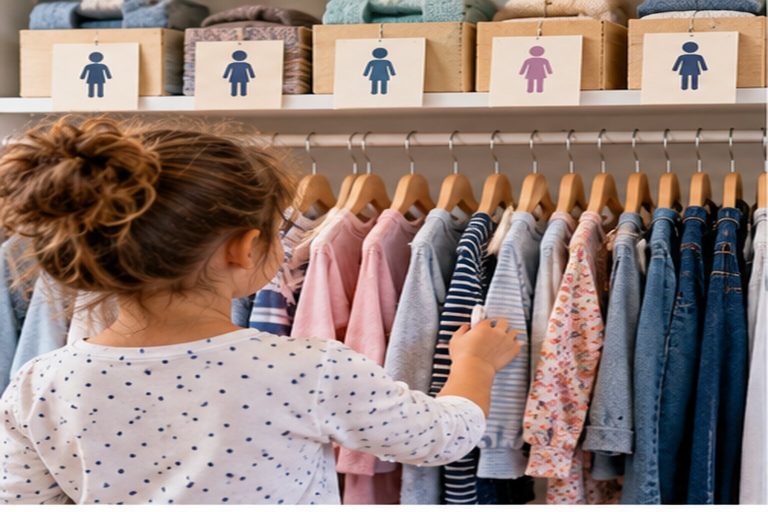
I think children’s wardrobes have a tendency to expand almost without me noticing.
A few extra T-shirts appear because they were reduced.
Someone gives us a jumper.
A multipack of leggings seems too useful to leave behind.
Then the season changes and I discover a drawer full of clothes, some worn constantly and others barely touched.
That is why I no longer think there is one correct number of clothes every child needs.
The more useful question for me is whether the wardrobe contains enough clothes to support ordinary life without creating unnecessary duplication.
I Start With the Laundry Routine
This determines more than almost anything else.
A child who has clothes washed several times a week needs fewer items than one whose household does most laundry at weekends.
If I can wash and dry clothes easily during the week, I do not need seven versions of everything simply because there are seven days.
On the other hand, if drying space is limited or laundry happens less frequently, additional basics can make life considerably easier.
I therefore build quantity around the actual household rather than an ideal minimalist wardrobe.
I Think About How Messy the Child Is
Age and activity make a huge difference.
A toddler can go through several outfits in a day.
An older child may wear the same pair of trousers more than once before they need washing.
A child who loves mud, painting, baking and outdoor play may need more everyday clothing than one whose routine places less strain on clothes.
Neither is wrong.
The clothes simply need to support the child’s life.
Underwear and Socks Are Where I Like a Buffer
These are washed after every wear, so I like more than the bare minimum.
For an everyday wardrobe, I might comfortably keep around ten pairs of pants and ten or more pairs of ordinary socks.
That gives me enough to cover the week, laundry delays and the mysterious process by which individual socks vanish.
I do not worry about being particularly minimalist here.
Small basics are inexpensive to store and genuinely useful.
T-Shirts Depend on How Often They Are Worn
If T-shirts form the child’s main everyday top, I might want around seven to ten.
That does not mean ten fashion tops plus ten school tops plus ten sports tops.
I look for overlap.
A plain T-shirt can work at home, under a sweatshirt and on an ordinary weekend outing.
The more jobs one garment can perform, the fewer clothes I need overall.
If the child wears school uniform five days a week, they may need far fewer casual tops than a child who wears their own clothes every day.
I Need Fewer Jumpers Than T-Shirts
Jumpers, hoodies and sweatshirts are usually worn over another layer.
They can often be worn several times before washing.
For many children, three or four useful casual jumpers may provide plenty of variety.
If one is constantly left at school or another lives in the sports bag, I might add another.
But I rarely need a different sweatshirt for every day of the week.
Trousers Can Often Be Worn More Than Once
Unless they are visibly dirty, many trousers, jeans and skirts do not need washing after every wear.
That means I usually need fewer bottoms than tops.
Perhaps four or five casual options are enough for a child who also wears school uniform.
For younger children who regularly kneel in mud or spill food, I may need more.
Again, I respond to the laundry basket rather than a fixed wardrobe formula.
I Separate Everyday Clothes From Specialist Clothes
A wardrobe may contain relatively few everyday outfits but still look large because specialist clothing takes up space.
There might be:
school uniform;
football kit;
swimming clothes;
dance clothing;
waterproofs;
formal clothing;
winter accessories;
holiday clothing.
These items perform different jobs.
I do not include them all when deciding whether the child owns “too many clothes”.
The more useful question is whether each category contains more than we actually use.
Sports Clothing Needs to Match the Schedule
If football training happens twice a week, one kit may not always be enough depending on washing.
If swimming happens once weekly, multiple swimming costumes may add little value.
I work backwards from the timetable.
This stops specialist clothing multiplying unnecessarily.
I Am Careful With Occasion Wear
Children can outgrow smart clothing before the next event arrives.
I therefore own very little clothing purely for special occasions.
A smart shirt, simple dress, neat trousers or another versatile outfit can often cover several different events.
I would rather re-style one suitable outfit than keep several expensive garments waiting for an occasion that may never come before they are outgrown.
Coats Take Up Space Quickly
Most children do not need a large collection of coats.
I usually want the functions covered.
Perhaps:
one everyday winter coat;
one lighter waterproof;
one lighter jacket for mild weather.
Depending on the child’s activities, two of these jobs may be performed by the same garment.
I do not need five winter coats simply to create colour variety.
I Think in Outfits Rather Than Individual Garments
This is one of the easiest ways I identify wardrobe gaps.
Imagine a child owns eight tops but only one pair of trousers they actually like.
Technically they have plenty of clothes.
Practically they have very few outfits.
I want the pieces to work together.
Neutral or easily combined bottoms make this simpler.
So do layers that work over several tops.
A wardrobe of twenty coordinated garments can be far more useful than forty unrelated ones.
I Let Favourite Clothes Influence the Numbers
Some children develop strong preferences.
They may want the same three tops repeatedly despite owning ten.
I take that as useful information.
Perhaps those three are softer.
Maybe the neckline feels better.
Perhaps the colours or designs are simply favourites.
Rather than constantly encouraging them to wear the ignored clothing, I might buy fewer items next time and choose more carefully around what they actually like.
I Keep a Small Amount of Spare Capacity
A very tight capsule wardrobe sounds efficient until a child is ill, clothes become muddy or the washing machine breaks.
I like a little buffer.
That might mean one or two extra everyday outfits beyond what we normally need between washes.
The aim is not to own the absolute minimum.
It is to own enough that clothing does not become a daily logistical problem.
Growth Makes Overbuying Particularly Wasteful
Children’s wardrobes have a built-in expiry mechanism.
Eventually the clothes stop fitting.
That makes buying twenty T-shirts in the same size risky.
Even if the price per item is excellent, I have saved nothing if six are barely worn before the child grows.
I prefer adding clothes gradually.
When the child genuinely needs more, I buy more.
I Review Clothes at the Start of Each Season
This is when I discover what we actually have.
I remove clothes that no longer fit.
I identify what can carry into the next season.
Then I look for genuine gaps.
Perhaps last year’s shorts still fit perfectly.
Perhaps every sweatshirt has become too short.
Maybe the child has plenty of tops but no lightweight jacket.
This prevents me buying a generic set of “new season clothes” regardless of need.
Hand-Me-Downs Need Editing Too
Free clothing can still create clutter.
If somebody gives me a bag of clothes, I do not automatically put everything into the wardrobe.
I check:
Does it fit?
Will the child wear it?
Do we already have enough of this?
Is it in good condition?
If the answer is no, I pass it on.
The fact that clothing cost me nothing does not make it useful.
Storage Gives Me Another Clue
If the drawers cannot close, I probably need to review what is in them.
Children benefit from being able to see and access their own clothes.
An overfilled drawer makes that harder.
It can also mean clothes at the bottom remain invisible until they are outgrown.
I prefer enough space that the wardrobe can actually function.
What Might a Practical Everyday Wardrobe Look Like?
For a school-age child who wears uniform during the week, I might start somewhere around:
seven to ten casual T-shirts or tops;
three or four sweatshirts or jumpers;
four or five casual trousers, jeans, leggings or skirts;
ten sets of underwear;
ten or more pairs of ordinary socks;
one or two pairs of everyday pyjamas in active rotation, with enough to cover washing;
a winter coat;
a lighter weatherproof layer;
activity-specific clothing as genuinely required.
These are not targets.
They are simply the sort of quantities I would use as a sense check.
A toddler may need much more.
A teenager who changes clothes rarely may need less.
My Test Is Whether Everything Gets Used
I do not worry much about the exact number.
I look at what happens over several weeks.
Are there clothes the child never chooses?
Do I regularly run out of basics?
Is laundry constantly urgent?
Are there six nearly identical garments when only two are used?
That tells me whether the wardrobe is working.
The right number of children’s clothes is enough to support ordinary family life comfortably, with a little spare capacity, but not so many that garments disappear into drawers and are outgrown before anyone remembers they exist.
That is a moving target.
And I am quite happy for it to change as the child does.