I have gradually stopped asking whether a particular style of jeans “suits” me.
I find that question too vague to be useful.
A much better question is whether the proportions of a particular pair work with my proportions.
That changes the way I shop.
Instead of deciding that I cannot wear high-rise jeans, wide legs or cropped denim because of some general rule, I can look at what is actually happening. Perhaps the waistband is too high. Perhaps the knee shaping is sitting too low. Maybe the jeans simply need a different inseam.
Those are practical problems I can investigate.
And very often, the problem is the particular pair rather than the entire style.
I Start With Fit Rather Than Body Shape
There are countless guides telling women which jeans to wear according to whether they are pear-shaped, apple-shaped, hourglass or something else entirely.
I have never found those categories particularly helpful.
Bodies are far more varied than four or five simple outlines suggest.
Two people with similar hip measurements may have completely different torso lengths. Two women of the same height can need different inseams. One person may have a significant difference between waist and hip measurements while another does not.
So I begin with the fundamentals of getting women’s jeans to fit properly.
Does the waistband stay in place?
Can I sit comfortably?
Is there enough room through the hips and thighs for the style?
Does the crotch sit naturally?
Are the knees where the garment seems to expect them to be?
Those questions give me something tangible to work with.
I Pay Particular Attention to Rise
Rise is one of the biggest influences on how jeans feel.
It determines where the waistband sits and how much fabric there is between the crotch and waist.
I can wear high-rise jeans, but not every high rise works for me.
Some sit comfortably around the natural waist.
Others reach too high and become uncomfortable when I sit.
The same applies to low and mid-rise jeans.
The label only gives me a general category.
Learning how high-, mid- and low-rise jeans change the fit is much more useful than deciding that I belong permanently to one camp.
I may prefer one rise with wide-leg jeans and another with straight denim.
That is perfectly reasonable.
Torso Length Makes a Difference
Height does not tell me how long my torso is.
That is important because the same rise can look and feel completely different on two people of identical height.
Someone with a shorter torso may find an ultra-high waistband reaches close to the ribs.
Someone with a longer torso may find it comparatively ordinary.
That is why I never assume a jean is wrong simply because it does not sit on me exactly as it does on the model.
The model and I may simply have different proportions.
I Look at Where the Hip Shaping Sits
The relationship between waistband and hips is another major factor.
If the waistband fits but the hips pull tightly, sizing up may leave me with a large gap at the waist.
That does not necessarily mean my body is difficult to fit.
It may mean the pattern has been designed around a different waist-to-hip relationship.
Some brands and cuts naturally provide more room through the seat and thigh.
Others are relatively straight through the body.
Trying a different cut is often more productive than endlessly changing sizes within the same jean.
Knee Placement Matters More Than I Used to Think
On a simple straight jean, knee placement is not always obvious.
On a flare, bootcut or barrel leg, it can be crucial.
If a bootcut begins widening several centimetres below my knee, the shape may look awkward even if the waist and length technically fit.
Likewise, if a barrel jean reaches its widest point in the wrong part of my leg, the intended curve can become distorted.
This is where standard sizing sometimes fails people at both ends of the height spectrum.
The overall length might be adjustable, but the internal proportions of the garment may still be wrong.
Petite Jeans Are About More Than Short Hems
If I need shorter proportions, I look beyond inseam alone.
A dedicated petite cut may adjust the rise, pocket position and placement of leg shaping as well as the length.
Understanding why petite jeans can fit differently from simply shortened standard denim helps me decide whether alterations are likely to solve the problem.
If ordinary straight jeans fit perfectly everywhere except the hem, I may simply shorten them.
If a bootcut flares in the wrong place and the rise feels too long, a petite cut may be the better solution.
I treat the category as another tool rather than a restriction.
Tall Jeans Present the Opposite Problem
For taller women, the challenge is often assumed to be simply finding enough fabric.
Length certainly matters.
But again, there is more to it.
A longer leg can mean the knee sits lower, the rise may need adjustment and a flare or barrel curve needs to happen at a different vertical point.
This is why finding jeans designed around taller proportions can make such a difference compared with repeatedly buying standard jeans in the longest available length.
There is also a practical advantage to starting long.
Jeans can usually be shortened.
Adding several missing inches is much harder.
I Measure Jeans, Not Just My Body
Body measurements are useful, but I find garment measurements equally valuable.
If I already own jeans that fit beautifully, I have a physical template.
I can measure:
- front rise;
- waistband;
- hips;
- thigh;
- inseam;
- leg opening.
Those numbers give me a point of comparison when shopping online.
For example, knowing that I consistently enjoy a front rise around a certain measurement is much more useful than simply searching for “high rise”.
The same applies to inseam.
I might discover that I like a relatively short straight jean but need considerably more length for bootcut denim.
Length Changes the Whole Proportion
This is particularly obvious with cropped jeans.
The hem introduces a horizontal line, so moving it only a few centimetres changes where the jean visually ends.
A crop that falls neatly around my ankle can look deliberate.
The same jean finishing higher up my calf creates a very different silhouette.
Full-length jeans have their own issues.
Wide legs, bootcuts and flares depend heavily on the relationship between hem and shoe.
So I never think of inseam as an isolated measurement.
It interacts with the leg shape and the footwear.
I Use Shoes When Assessing Proportions
This has made a big difference to me.
I used to decide whether jeans fit while standing barefoot or in whatever shoes I happened to be wearing.
Now I try the footwear I expect to use.
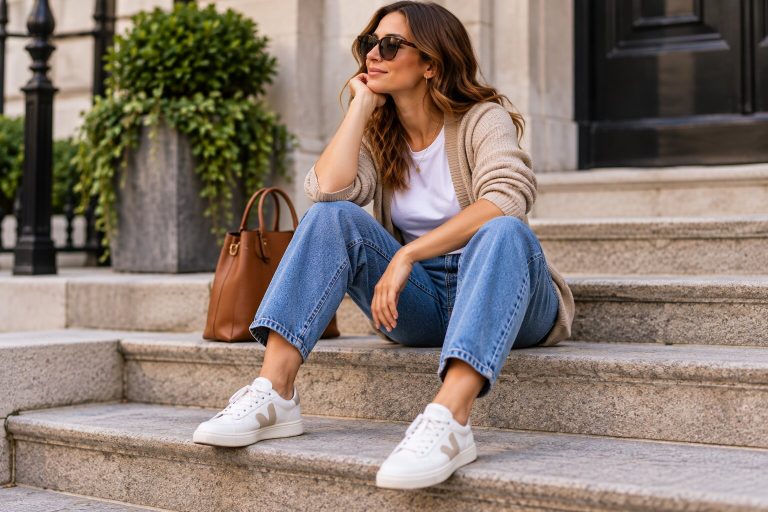
A wide leg that seems too long in socks may sit perfectly over trainers.
A bootcut designed around a heel can look oddly short with flats.
A cropped straight jean can suddenly make complete sense once I put on loafers.
The jeans, body and shoe create the final proportion together.
I Photograph Myself
Mirrors can be misleading because I am standing close to my reflection and looking from unusual angles.
A photograph from several feet away gives me a better sense of the complete silhouette.
I take a front, side and back photograph.
I pay particular attention to where the waist appears, how the leg shape develops and where the hem finishes.
This often helps me distinguish between “I am not used to this silhouette” and “the proportions genuinely are not working”.
Those are very different conclusions.
I Do Not Try to Correct My Body With Jeans
I am wary of advice that talks constantly about elongating, slimming, balancing or disguising bodies.
Clothing certainly changes visual proportions.
That is part of design.
But I do not think every decision needs to be driven by an attempt to make my body look taller, narrower or closer to a standardised shape.
Sometimes I want wide jeans because I enjoy volume.
Sometimes I want cropped denim because I like seeing my shoes.
Sometimes I want a high waist because I like the way it interacts with a tucked shirt.
Those are legitimate reasons.
I Change the Garment Before Blaming the Style
If a pair feels wrong, I work through the variables.
Could the rise be lower?
Could the leg be longer?
Would a petite or tall version reposition the shaping?
Would softer denim change the way the fabric falls?
Would a different cut provide more hip room without increasing the waist?
Only once I have explored those questions do I decide that the style itself is not for me.
Quite often, another version works.
Proportion Gives Me More Freedom, Not More Rules
The more I understand my measurements, the less restricted I feel.
I do not need a list telling me which jeans I am allowed to wear.
I simply need to recognise why some garments work more easily than others.
My proportions are information.
The jeans have proportions too.
Shopping is largely the process of finding a good relationship between the two.
Once I started approaching jeans that way, the whole category became much less mysterious.