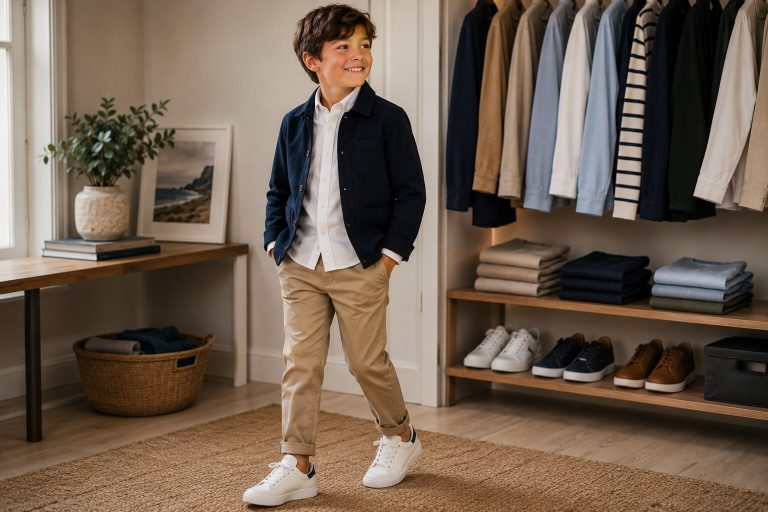
When I buy school uniform in late summer, there is always a temptation to imagine September’s neat clothes surviving unchanged until July.
They will not.
Children grow.
Knees wear.
White shirts acquire mysterious stains.
Jumpers disappear.
My goal is therefore not to make every item literally last untouched for twelve months.
I want to maximise the chances that the uniform remains wearable and presentable for as much of the school year as possible without starting with clothing that is far too big.
I Measure Before the Main Shop
Children can grow surprisingly between the end of one term and the beginning of another.
I do not rely on last year’s age size.
I measure height.
For trousers, I look at waist and inside leg.
For shirts, chest and sometimes collar matter.
Then I check the retailer’s actual chart.
The correct current size gives me the foundation.
Only then do I think about growth.
I Choose Growing Room Strategically
I want a little flexibility where growth is likely to show first.
For trousers, that often means leg length.
For shirts and jumpers, sleeves may matter.
But I do not simply buy everything one or two ages larger.
Oversized shoulders, waists and necklines make uniform uncomfortable and can look untidy.
I prefer design features that allow growth without making the entire garment too large.
Adjustable Waists Are Extremely Useful
This may be my favourite school-uniform feature.
Children often need trouser length from one size but a smaller waist.
Internal elastic adjustment lets me combine those needs much more successfully.
If I can buy a slightly longer pair and bring the waist in neatly, I may gain several months of useful life.
I still check for excessive bunching.
Adjusters cannot rescue trousers that are dramatically too large.
I Look for Additional Length Options
Some schoolwear ranges offer short, regular or long versions within one waist size.
That is even better than sizing up.
It allows me to solve the length problem directly.
Likewise, slim and plus fits can address body proportions without forcing me into an inappropriate overall age size.
I use targeted sizing wherever available.
I Inspect the Knees
School trousers often fail at the knees before anything else.
I feel the fabric.
For a child particularly hard on trousers, I look for reinforced knees or sturdier materials.
I also avoid extremely thin fabrics purely because they feel soft in the shop.
Softness and durability are not mutually exclusive, but the knees need enough substance for the child’s normal activity.
I Look Closely at Seams
I turn trousers and skirts inside out.
Crotch seams, inside legs and pocket corners experience repeated strain.
On shirts I look under the arms.
On jumpers I inspect cuffs and necklines.
A garment that is already showing loose or unstable stitching before the term starts does not inspire confidence.
Wash Performance Matters as Much as Playground Strength
Uniform is washed repeatedly.
I want fabric that can survive that routine.
I read reviews for repeated comments about:
shrinking;
fading;
pilling;
collars curling;
skirts losing pleats;
trousers becoming shiny.
One review proves very little.
A recurring pattern across dozens of customers is useful information.
I Read Care Labels Before Buying
If trousers need a laundry routine that does not fit my household, I know that before buying five pairs.
For ordinary uniform I value simple machine-wash care.
I also check drying instructions.
If I rely heavily on a tumble dryer, a product that cannot tolerate one may be less useful for us.
Practicality is part of durability because clothes only last well if I can care for them correctly.
I Avoid Overbuying the Current Size
Ironically, one of the ways I make uniform “last the year” is by not trying to buy the entire year at once.
Perhaps I buy three pairs of trousers in September.
If the child grows dramatically by February, I replace them then.
That can be cheaper than buying six pairs in August and discovering all six become too short simultaneously.
I buy enough for rotation, not enough to stock a shop.
Dark Colours Need to Stay Dark
Black, grey and navy uniform can look tired once colour begins fading.
I follow the care instructions and avoid unnecessary washing.
A jumper worn over a shirt may not need laundering after one ordinary day.
Reducing needless wash cycles can help clothing remain presentable for longer.
Obviously visible dirt overrides this principle.
Children are very effective at ensuring that.
I Choose Easy-to-Replace Generic Items Where Allowed
Current England guidance requires schools to minimise branded requirements, with a legal cap from September 2026 of three compulsory branded items, or four at middle/secondary school where one item is a tie.
Where the policy allows generic shirts, trousers or skirts, I value that flexibility.
If something fails midyear, I can replace one item without relying on a specialist supplier.
I Use Second-Hand Uniform for Expensive Items
A well-made blazer may easily outlast the first child who owns it.
The same applies to jumpers and some PE clothing.
Current Department for Education guidance requires schools in England to ensure opportunities to acquire second-hand uniform are available and clearly communicated.
I check there before buying expensive spares.
I Label Clothes Properly
There is little value in buying durable clothing if it disappears in October.
Names go into:
jumpers;
blazers;
coats;
PE tops;
sports shorts;
bags.
A secure label increases the chance that an item eventually returns from lost property.
Iron-on, sew-in and stamp systems can all work.
I simply choose one I will actually use consistently.
I Repair Early
A small loose hem is much easier to fix than one that has unravelled halfway around the trouser leg.
A loose button takes minutes.
A tiny hole can be repaired before it grows.
I try to deal with small failures as soon as I notice them.
School uniform does not have to remain factory-perfect.
It needs to remain functional.
I Rotate Rather Than Wearing One Favourite Constantly
If the child owns several suitable shirts or trousers, I rotate them.
Otherwise one favourite pair can receive almost all the wear while the others remain pristine.
This also helps me discover whether one brand or style is significantly outperforming the others.
That information guides the next purchase.
I Expect One Growth Replacement
Sometimes planning becomes easier when I stop insisting that everything must survive until July.
Children grow.
If trousers need replacing in spring because the child has grown several centimetres, that is not necessarily a purchasing failure.
I distinguish between:
outgrown;
worn out prematurely;
lost.
Only the second and third suggest a problem I might solve differently next year.
I Spend More Where It Will Matter
I may pay a little more for:
a blazer used daily;
a strong winter coat;
trousers that consistently survive knees;
a specialist fit that works properly.
I am less interested in premium pricing for basic white shirts if an inexpensive product performs just as well.
Current Department for Education guidance similarly emphasises quality, durability and value for money rather than price alone.
I Review Uniform Halfway Through the Year
January is a useful point.
I check:
trouser length;
shirt cuffs;
shoe fit separately;
jumpers;
PE clothing.
If something is becoming small, I can replace it before it becomes an emergency.
I would rather buy one correct pair in January than spend February telling a child to pull down trousers that no longer reach their ankles.
Lasting the Year Means Maximising Useful Life
That is how I interpret the goal.
I measure before buying.
Use adjustable and alternative fits where possible.
Choose fabrics and construction suitable for the child’s activity.
Avoid overbuying.
Wash appropriately.
Repair early.
Use second-hand clothing where it makes sense.
And accept that growth sometimes wins.
A successful school-uniform purchase is not necessarily the garment still fitting perfectly on the final day of term.
It is clothing that gives me a good, practical amount of use before there is a genuine reason to replace it.
Sources and Research Notes
Current Department for Education statutory guidance in England requires schools to prioritise affordability and value for money, including quality, durability and sustainability. It also encourages access to second-hand higher-cost items.
From September 2026, compulsory branded items are legally capped as set out in the current guidance.