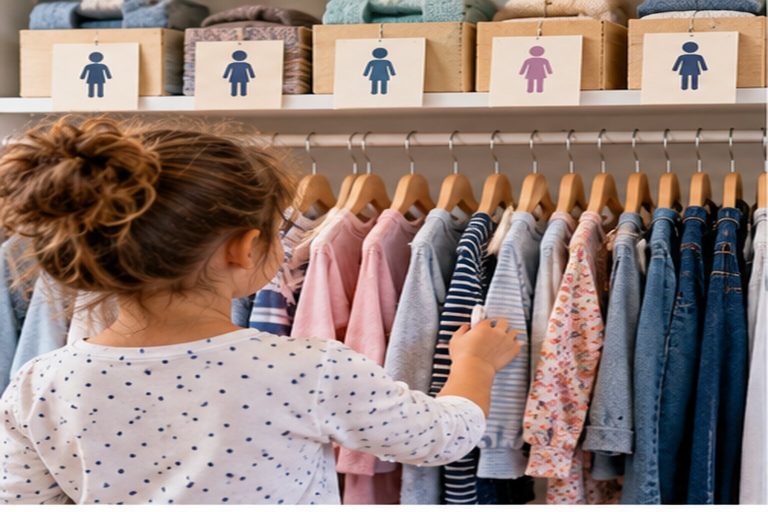
For some children, clothes are not simply comfortable or uncomfortable.
A label can feel unbearable.
A seam can dominate their attention.
A waistband can feel painfully tight even when it appears perfectly ordinary to somebody else.
Certain fabrics may be completely unacceptable.
When sensory sensitivities affect clothing, I find ordinary shopping advice becomes much less useful.
The question is no longer whether I think the garment feels nice.
The question is whether this particular child can tolerate wearing it.
I Believe the Child’s Response
This is my starting point.
If a child repeatedly says a garment hurts, scratches or feels wrong, I do not assume the problem is imaginary because I cannot feel it myself.
The National Autistic Society notes that sensory sensitivities can make labels, prominent seams and certain fabrics feel extremely itchy, distracting or even physically painful for some autistic children and young people.
That gives me a useful mindset even when the child does not have an autism diagnosis.
The child’s sensory experience is real to them.
I shop accordingly.
I Find Out What the Actual Problem Is
“Doesn’t like clothes” is too broad to shop around.
I try to identify the details.
Is it:
the label?
a side seam?
the waistband?
tight cuffs?
socks?
buttons?
denim?
a particular fabric?
clothes touching the neck?
too much loose fabric?
Sometimes a child prefers tight clothes because they like the pressure.
Another may need loose garments.
I do not assume sensory-friendly always means oversized.
I Start With Proven Success
If the child already owns something they happily wear, that garment is incredibly valuable information.
I examine it.
What fabric is it?
How is the neckline made?
Does it have labels?
How wide is it?
What type of waistband?
Are the seams flat?
Does it stretch?
I may even photograph the care label so I can remember the fibre composition.
Instead of searching the entire clothing market, I look for products with similar characteristics.
Softness Is Often Important
National Autistic Society research conducted with parents found soft fabric to be an important preference, alongside easy dressing and avoiding labels and difficult fastenings.
I therefore feel every garment internally as well as externally.
Brushed interiors can be wonderful for one child and intolerable for another.
I never assume.
I use the existing successful clothes as my reference.
I Look for Label-Free Designs
Printed care or brand information can be extremely useful when sewn labels are a known trigger.
I also look at side-seam labels.
These are sometimes forgotten because shoppers focus on the neck.
For a sensitive child, a small label rubbing against the waist can be just as disruptive.
If I remove labels, I do it cleanly rather than leaving sharp remnants.
Seams Matter Enormously
I turn everything inside out.
A garment that looks simple externally may have thick internal seams.
I run my fingers along the shoulder, side and armhole seams.
I inspect sock toes in particular.
Some sensory-friendly clothing is specifically constructed with flatter seams, but I can also find ordinary garments whose construction happens to suit the child perfectly well.
I shop for the feature rather than assuming I always need a specialist label.
Waistbands Can Make or Break Trousers
Elastic waistbands vary enormously.
Some are broad and soft.
Others are narrow and firm.
Internal adjustable elastic can introduce buttons or bunching that a sensitive child dislikes.
Drawstrings may feel easier for one child and irritating for another.
I test the waistband with my hands and ask the child to move in it.
Sitting down is particularly revealing.
Socks Deserve Their Own Strategy
Sock seams can become a major source of distress.
If this is an issue, I search specifically for smooth or seamless-toe designs.
I also consider fit carefully.
A sock that twists inside the shoe may be as problematic as the seam itself.
Once I find one that works, I am quite happy to buy multiple identical pairs.
This is not an area where variety adds much value.
Underwear Needs Careful Testing
Elastic, leg openings and internal labels all come into play.
Again, I buy one pack or one style first rather than replacing the whole drawer.
If it works after washing and wearing, I buy more.
Sensory-friendly shopping rewards repetition.
There is no reason to keep experimenting once I have found something the child is comfortable in.
Easy Dressing Can Reduce Stress Too
Sensory issues and dressing difficulties can overlap.
The National Autistic Society’s parent research highlighted pull-on clothes, easy dressing, no labels, fewer buttons and simple fastenings as desirable features for many families.
I therefore look at the entire dressing process.
A top may feel fine once it is on but be difficult to pull over the head.
A zip may be uncomfortable against the skin.
A buttoned shirt may simply involve too many steps.
The most suitable clothing reduces both sensory discomfort and dressing friction.
I Am Cautious With “Sensory-Friendly” Marketing
The label can be useful.
It tells me the manufacturer has probably considered features such as seams, tags or fastenings.
But children have different sensitivities.
A sensory-friendly sweatshirt can still be completely wrong for one particular child.
I read the details.
What exactly has been changed?
Tag-free?
Flat seams?
Soft fabric?
No buttons?
Those features matter more than the marketing category.
I Involve the Child Before Removing Labels
If returns allow it, I let the child try the garment properly before I make irreversible changes.
They move around.
Sit.
Raise their arms.
Wear it for a few minutes.
A child may reject something instantly, and that is valuable information.
I do not remove tags, wash it or alter it until we are reasonably confident.
I Introduce Change Gradually
If the child wears only a very small range of clothes, I do not try to replace everything at once.
I start from what already works.
Perhaps the same T-shirt in a different colour.
Or a sweatshirt in a similar fabric.
If the child wants to experiment, small changes may be easier than a completely unfamiliar outfit.
I do not force novelty for its own sake.
I Keep Clothing Predictable
Some children find predictable clothes reassuring.
That can mean owning several identical tops.
I see nothing wrong with this.
Adults often own multiples of socks, underwear and favourite basics too.
If one particular product removes daily distress, buying five of it can be an extremely rational wardrobe choice.
The only caution is growth: I avoid buying so many that the child outgrows them before they are used.
I Pay Attention to Temperature
Some sensory-sensitive children also find temperature particularly uncomfortable.
I like layers because they allow adjustment.
A soft base garment combined with removable outer layers gives the child more control than one very heavy piece of clothing.
Again, their individual preference matters.
I Plan Ahead for Uniform and Occasions
School uniform can be difficult because the choice is restricted.
If I know the child struggles with certain features, I test uniform early rather than the night before term starts.
The same applies to weddings, performances and other events.
I do not want an unfamiliar formal outfit becoming a crisis on the day.
If a sensory-friendly alternative can still satisfy the practical requirement, I prefer that.
I Do Not Make Appearance the Priority
There may be times when an adult would prefer the child to wear something smarter, more varied or more fashionable.
I weigh that against the level of distress involved.
For me, ordinary children’s clothing needs to be wearable first.
A perfectly coordinated outfit has little value if the child cannot concentrate, play or enjoy themselves because it feels unbearable.
I Ask for Help When Clothing Is Seriously Limiting Life
Sensory clothing difficulties can range from mild preferences to severe distress.
If clothing intolerance is preventing a child attending school, leaving the house or carrying out normal daily activities, I would not treat it simply as a shopping challenge.
I would seek appropriate professional support.
The National Autistic Society’s community examples show just how significant clothing sensitivities can become for some families.
My Buying Rule Is Individual
I do not have one sensory-friendly shopping list.
I have a process.
Identify what bothers the child.
Study what already works.
Search for those features.
Buy one first.
Test it.
Then repeat success.
That approach respects the fact that the child’s sensory experience, not the label on the garment, determines whether clothing is truly comfortable.
Sources and Research Notes
The National Autistic Society reports that clothing sensitivities may involve labels, prominent seams, fabrics, tightness and dressing requirements. Its research with parents also highlighted soft fabrics, pull-on clothing, label-free garments and easier fastenings.
Its community resources also illustrate that sensory clothing difficulties can range from minor irritation to severe limitations on everyday activities.